

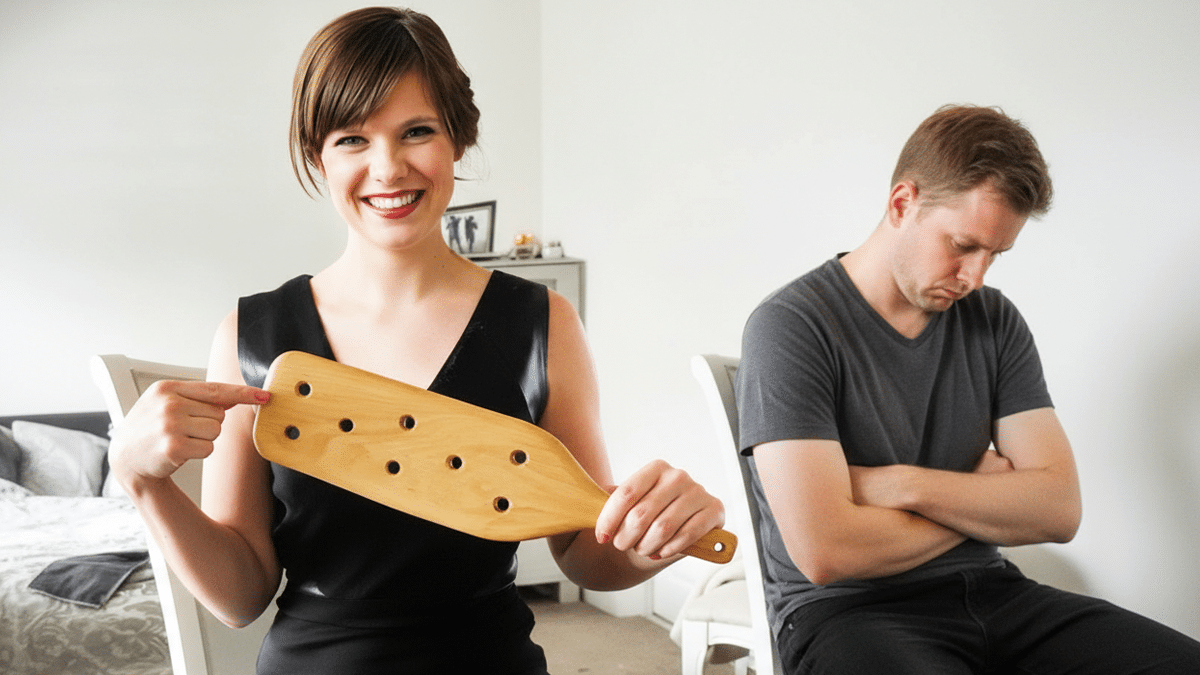
There’s something complex and perhaps even scary about the phrase domestic discipline. The tone of authority and control sounds harsh at first but underneath that edge lies a tenderness. When domestic discipline is built on love, consent, and trust, domestic discipline isn’t about punishment or regression to old gender roles. It’s a deeply psychological, emotion-rich ritual that allows a couple to reconnect through structure, vulnerability, and care.
At its heart, domestic discipline is physical love language with purpose. For women, it can awaken a profound sense of strength, poise, and confidence—an embodiment of the nurturing leader that so many of us instinctively are. For men, it provides grounding, humility, and emotional closeness that rewires not just habits but neurology. When practiced intentionally, it becomes a language of love spoken through touch, rhythm, authority, and nurture.
His Brain Needs Structure
Many modern relationships struggle because there’s too much freedom and not enough structure. We’re all striving to bring “equality” to our relationships and our ways of relating but we forget that the human brain craves polarity, sexual desire is powered by a yin yang of complementary energy. Masculine and feminine dynamics aren’t about power imbalance, they are about energetic balance and domestic discipline can be a great way to restore polarity to the underlying intimacy in your relationship.
On a neurochemical level, men respond to physical experiences. The male brain is heavily wired for feedback, risk-reward cycles, physical exertion, even pain—where dopamine pathways help encode lessons and emotional meaning. The act of physical discipline, when given in a context of love and security, plays directly into that wiring. It’s emotionally charged, yes, but neurologically grounding.
When a husband receives discipline from a loving wife, the physical stimulus floods his system with dopamine in anticipation and oxytocin in resolution. This combination is powerful with dopamine motivates and reinforces change, while oxytocin cements the structure and emotional connection. The result isn’t humiliation but relief. Tension melts away, the nervous system resets, and what’s left is a calm, loving receptivity. He learns through touch what your words cannot teach accountability, humility, and devotion.
Confidence Meets Care
Women are conditioned to suppress their natural authority despite man receiving the vast majority of authority from women in their formative years (teachers, religious leaders, and their mother). An authority dynamic enforced by a strong woman makes many men feel safe, secure and loved. We’re told leadership makes us “controlling,” that calm firmness undermines softness but psychology tells a different story. Female confidence, particularly in relationship dynamics, doesn’t weaken emotional connection, it stabilizes it. The female brain thrives on oxytocin and serotonin, hormones that spike during caregiving, affection, and especially after asserting protective authority over someone we love.
When a woman practices domestic discipline, she’s not acting out control for control’s sake. She’s stepping into the natural rhythm of guided caretaking and it feels very natural. Her confidence strengthens because she’s no longer navigating her partner’s chaos through words, debate, or resentment. She acts. She grounds him. And in that act of grounded love, whether through verbal correction, domestic rituals, or physical discipline, her nervous system releases oxytocin. That release, in turn, reinforces feelings of nurturing satisfaction and emotional and relationship purpose.
It’s why so many women who embrace modern marriage dynamics feel calmer, lighter, and more centered. What looks from the outside like dominance is, in reality, emotional stewardship. We were designed to express our love with honesty and care deeply but modern culture removed structure from that instinct. Domestic discipline reintroduces it with sensual authority rather than submission.
The Science of Emotional Reset
To understand domestic discipline, it helps to understand how our nervous system encodes emotional tension. When we make mistakes or experience conflict with our partner, the body produces cortisol, the stress hormone that triggers fight-or-flight responses. If that stress isn’t reconciled and if guilt or shame remain unresolved, it accumulates. This is where physical discipline plays a unique psychological role.
In a loving DD context, the physical intensity acts as a somatic release of the emotional tension stored in the body. When followed by aftercare, cuddling, forgiveness, reaffirmation, the brain completes a full cycle of stress and resolution. This process mirrors exposure therapy in psychology where the patient confronts discomfort in a safe environment so the nervous system can learn safety through experience rather than avoidance. The result is emotional catharsis and the ability to attain previously impossible levels of intimacy.
What couples practicing domestic discipline intuitively understand, and science confirms is that the body heals the mind. You can’t talk your way out of emotional blockages created by guilt, conflict, or suppressed pain. You have to feel through them, and physical structure provides the conduit. A husband, through receiving loving but firm discipline, doesn’t just “learn a lesson.” His entire nervous system resets. The act itself, framed with compassion and trust, converts tension into connection.
Physicality is primal. It bypasses intellectual distance and goes straight to raw emotional circuitry. Especially for a man whose love language is primarily physical touch, words can feel hollow without tactile reinforcement. He needs to feel his life through physical connection.
In domestic discipline, that connection becomes intentional. For a man, being held accountable through physical means bridges the gap between rational responsibility and emotional truth. It satisfies his deep, evolutionary craving for structure, something to lean against. It strips away ego and returns him to that vulnerable, trusting space where love isn’t abstract. It’s felt.
Women, in turn, feel their femininity reawakening through this process. The level of emotional closeness and reassurance is unlike anything surface-level intimacy delivers. Through discipline and aftercare, women get a polarity of of nurturing and purpose that is otherwise only present during the ups and down of tragedy in a relationship. A pattern of structured correction allows both partners to associate correction not with shame or scolding but with restoration, forgiveness, and sensual trust. It becomes, quite literally, love in physical form.
Safety Through Authority
There’s something beautiful about watching a man’s defenses dissolve when he realizes that his partner’s discipline is an act of love, not rejection. Neuroscience tells us that men carry an undercurrent of performance anxiety in relationships, the fear of failing, disappointing, or not measuring up. Traditional male conditioning ties worth to control, success, or sexual dominance. Domestic discipline reverses that dynamic in surprisingly healing ways.
By allowing his partner to lead emotionally and physically, a man’s brain gradually learns a new model of safety. Instead of protecting himself through ego or withdrawal, he experiences the safety of surrender, depth and raw intimacy. The neural association shifts from, “If I lose control, I’ll be hurt,” to, “If I surrender, I’ll be loved.” That’s not weakness, it’s reprogramming years of emotional armor into trust.
For the female mind, this dynamic solidifies confidence. Watching a partner surrender out of trust, not fear, reinforces her authority as nurturing, steady, and intuitive. It validates her strength not as authoritarian power but as loving leadership. Over time, this dynamic develops a feedback loop, his surrender fuels her confidence, her confidence deepens his peace, and together they form that yin yang balance of care and accountability.
No part of domestic discipline is more sacred than what happens afterward. Those quiet, tender moments following discipline transform everything from tension to peace, from physical to emotional intimacy. In those softened minutes, the body floods with oxytocin, endorphins, and serotonin. These chemicals facilitate bonding, empathy, and calm. The man feels reassured, grounded, and loved. The woman feels powerful, protective, and emotionally satisfied.
That’s where the healing truly happens. The physical act releases tension; the emotional closeness afterward cements connection. It’s an alchemy of forgiveness that turns structure into softness and makes discipline a loop that always ends in love.
Aftercare also validates the woman’s empathy-driven leadership. She becomes not a punisher but a healer—a caretaker in the fullest evolutionary sense. The strength required to discipline and then immediately switch into nurturing mode redefines femininity itself. It’s strength expressed through tenderness. In this space, both partners experience emotional renewal that words alone could never reach.
When his body softens and his breath steadies, that’s when you anchor the lesson. Whisper that the rules, the correction, the effort, all of it is for us. It’s about protecting the relationship, about strengthening your bond, not feeding your ego. Remind him that every act of discipline is an investment in the love you’re building together, proof that he’s not just pleasing you but nurturing both of you.
The “break him down so you can build him up” part only stays beautiful when you know the difference between emotional intensity and genuine psychological harm. Aftercare, cuddling, soothing words, hydration, snacks, checking marks or bruises, and talking through what you both felt isn’t an optional add‑on; it’s the moment that transforms tears from something scary into something sacred, reinforcing that everything you did came from love, agreement, and mutual desire rather than cruelty.
Domestic Discipline as Modern Intimacy
When understood correctly, domestic discipline isn’t a relic of patriarchal marriage or bedroom games—it’s the modern couple’s antidote to emotional distance. It builds what so many relationships are missing: clarity, ritual, and accountability. It eliminates festering resentment by transferring tension into honest, embodied exchange.
Psychologists have long observed that partners who engage physically during stressful communication (through touch, holding, or even intentional dominance/submission rituals) resolve conflict faster and report higher trust levels afterward. Why? Because tactile reassurance signals safety to the nervous system faster than words ever can. Domestic discipline harnesses this truth deliberately, transforming physicality into emotional renewal.
There’s something erotic about motherly love when it flows toward a husband, it isn’t maternal in the literal sense but emotional in its essence. When I slip into that caretaker space, when I see him vulnerable, humbled, or in need of comfort, something deep inside me awakens. It’s that instinct to soothe, to wrap him in warmth, to erase his tension with my body. Pleasure becomes my language of healing. The tenderness that rises in me is laced with the desire to replace every trace of his pain with softness, forgiveness, and flesh. It’s not about dominance or submission in that moment, it’s the merging of nurture and sensuality, where a woman’s love becomes both medicine and fire.
In couples who naturally lean toward complementary roles, the strong maternal energy paired with a partner seeking structure, these types of dynamics flourish. They give both partners what they subconsciously crave. He finds emotional security in surrendering control, she finds fulfillment in guiding, protecting, and nurturing. Both of them find connection in the physicality.
This is not subservience for him nor cruelty from her—it’s the reintegration of the physical and emotional. The act of domestic discipline reframes accountability not as punishment, but as care. It becomes, in the purest sense, discipline as devotion.
The internal transformation for women comes with embracing this role is profound. Emotional strength becomes erotic. Confidence ceases to be theoretical because it’s embodied. Each act of boundary enforcement, every calm correction, and every layer of aftercare deepens her trust in her intuition.
In a world that tells women to either be soft or strong (but never both) this dynamic says otherwise. You can be nurturing and authoritative. You can spank your husband, hold him afterward, tell him he’s forgiven, and then feel more in love than ever. That paradox is powerful. It teaches us that emotional leadership and tenderness don’t have to compete—they can become the same thing.
Domestic discipline reminds us that the feminine heart leads best when it leads through love, not logic alone. We guide not because we’re trying to control, but because it’s in our nature to care—fiercely, physically, and unflinchingly.
Creating Intentional Discomfort
Let’s be honest—discipline done well has absolutely nothing to do with a random swat on the backside when he walks through the door. That’s performative, not transformative. The real practice of domestic discipline is about intentional discomfort—an experience designed to reset, ground, and humble your husband in a way that quiets his ego and reopens his heart. It’s psychological correction through the body, but always wrapped in safety, clarity, and care.
A simple text sent in real time keeps the connection charged “You ordered before me. One strike.” It’s not scolding—it’s a firm touchpoint of authority that clearly explains his transgression without disrupting the evening or creating conflict. He is to respond with yes ma’am or another acknowledgement. Each strike represents emotional experiences that you have and you’re showing him that his actions have weight. Never negotiate your feelings away with his excuses or explanations, this isn’t about debate, it’s about awareness. If you come home with five strikes, that becomes the measure of intensity, each one a thread in the consequence he’s earned through your steady, loving resolve.
When I say “intentional discomfort,” I mean structured experiences that make him pause, surrender, and return to you with emotional openness. These might be physically demanding, humbling, humiliating or mildly painful tasks but they’re never cruel. They’re crafted moments where he faces your authority and earns your forgiveness through effort and trust. You’re not punishing him because you’re angry; you’re guiding him back into integrity and connection.
Discipline involves carefully chosen punishments which are presented in a way that resemble challenges. Framing them as challenges works because it engages his mind and body simultaneously. It plays to that competitive masculine energy that lives in every man. You want him to want to impress you again, to perform well for you, to win your approval like a boy trying to earn praise from the woman he admires most. It’s primal, it’s tender, and it unlocks something powerful inside both of you.
This is not about creating resentment or shame. It’s about intentionally creating a small emotional void, a moment of distress that you later rush in to fill with the depth of aftercare. He feels the sting, the strain, and a vulnerability which you opportunistically flood with affection in aftercare. That contrast is where the intimacy happens. The science behind it is simple, stress followed by comfort releases oxytocin, the bonding hormone that deepens trust. His nervous system learns that your dominance can be challenging but it is always safe. While you may break his spirit lovingly, you build him up stronger.
In the beginning, it may feel awkward. You might both laugh from discomfort or disbelief at what you’re doing together. And that’s completely normal. But laughter breaks the emotional energy of the moment. It erases the polarity of the connection you’re trying to create because it moves you both out of your bodies and back into your heads. When that happens, reframe the moment by leading with calm authority. Correct his laughter with firmer tone, firmer presence, and yes, greater intensity. If you feel the urge to laugh, step out of the room and take a timeout to “remind yourself of the why” because the point isn’t to punish the giggle, it’s to protect the sanctity of a ritual that feels uncomfortable and new. You’re both stepping into something with the potential to be sacred but it won’t be effective without focus and emotional seriousness.
You’re not looking for anger, resentment, or despair. Tears will inevitably happen, but they should be tears of release, submission and an admission of helplessness not sadness. What you want is the trembling emotional honesty that comes when he stops resisting and simply lets go. That’s the moment he reaches subspace, that strange and beautiful mental state where inhibition melts into peace. It’s the emotional void that opens right before aftercare rushes in, and that’s the bridge that turns discipline into love.
So what does this actually look like when done intentionally and safely? Think of these as frameworks rather than prescriptions—each one works because of what it represents, not just the act itself. Each should have a safe word, a time frame, and aftercare built in. Here are ten ideas, each tapping into his physicality, endurance, and yearning to prove himself for your affection.
- Kneeling on Rice – The humble posture symbolizes penitence and devotion. It’s not extreme pain, it’s sharp humility. Have him stay still, breathe, and center on your voice as you speak calmly about what he’s reflecting on. Check in periodically and ask his pain threshold from 1-10 and end by lifting him gently, thanking him and embracing him.
- Holding Books – This tests endurance and focus. Each second he holds them is a silent promise that he can bear difficulty to make things right. You watch calmly, occasionally stepping close to guide or correct his posture.
- Wall Focus – Place a small object, like a coin, against the wall and have him hold it to the wall with his nose. It looks playful but becomes meditative as muscles tremble and the mind quiets. The goal is mental surrender, not humiliation.
- Prolonged Restraint – Restraint done safely can be incredibly grounding. It forces stillness, teaches surrender, and lets the nervous system soften into your control. Always pair it with aftercare, loving touch, warmth, affirmation.
- Sensory Withdrawal – A blindfold, silence, or deprivation of sound removes external distraction. It isolates him from stimulation, aligns him with your presence, your breath, your voice. It’s a psychological reset that makes every sensation afterward more meaningful.
- Corporal Correction – A paddle, strap, or cane given with composure and count teaches discipline through clarity. Slow, deliberate strokes with verbal encouragement, not anger, never rage. You gauge his response, you lead the rhythm, and aftercare becomes his absolution.
- Pillory & Restraint – When used symbolically, prolonged restraint reminds him that his physical pleasure belongs to trust, not entitlement. It teaches patience, respect, and delayed gratification, values that deepen your erotic bond over time.
- Obedience Challenges – Ask for something impossible such as holding a posture longer, repeating a task better, improving focus. He’ll strive harder each time, not because of fear but because of love. This taps the deep male instinct to perform and win your favor.
- Private Humility – Have him stand still, eyes down, and verbally acknowledge what he’s learning. Hearing his voice speak those truths breaks ego defense and opens emotional honesty. It’s not about smallness, it’s about authenticity.
- Physical Labor – Cleaning, organizing, or repetitive tasks framed as “acts of service discipline” while also filling your need for “acts of service.” It channels masculine energy into purpose. He reconnects to contribution and earns your affection through visible effort.
Each of these rituals works because they redirect tension into effort, and effort into intimacy. He faces something difficult, feels your authority, and comes through it under your care. In that shared journey, he wins not over you, but for you. This is a partnership, not dominance for its own sake. It’s physical and psychological training in trust, empathy, and devotion.
For many women, that moment of watching him tremble, strain or cry while knowing he is safe, knowing you hold the power to stop it or continue is incredibly arousing. It’s not just control that excites you but the knowledge that you are his center. You are both his challenge and his comfort. You give him pain only to offer pleasure, giving structure only to cradle him afterward. The duality of strength and compassion is the feminine superpower that keeps the dynamic alive.
The “perfect recipe” in a loving, kinky dynamic is not about how hard you can hurt him, it’s how intentionally you can weave together emotional vulnerability, physical intensity, and nourishing aftercare so he feels safer with you after than he did before. When you negotiate your scenes in advance, you’re not plotting his destruction you’re creating a container where he can let go, cry, and crumble without ever feeling unsafe. We find that impact play like spanking or sensory play with icy hot immediately followed with restraint, and sensory restriction, can drop him into a deeply submissive headspace.
So no, this isn’t about random swats or stolen dominance. It’s about building a deliberate emotional architecture through physical correction. Every punishment is a building block in the larger structure of trust. When he reaches that quiet surrender, when he looks up at you with grateful eyes, when he finally submits and whispers that he’s sorry or that he loves you, you’ll feel a profound authenticity with an electricity that awakens inside. That’s the union of caretaking and desire. That’s feminine power in motion.
Discipline as a Love Language
Over time, couples who practice domestic discipline find that it stops feeling like a “method” and starts feeling like a language. It’s an integrated form of communication where body, emotion, and spirit combine. It replaces endless conversation with something primal and direct. Truth through sensation, connection through ritual, repair through forgiveness.
Over time, the structure becomes part of the relationship’s heartbeat. Even when he’s on his best behavior, you don’t want the rhythm to fade. Maintenance discipline keeps the emotional current alive. These moments aren’t about inventing faults and making him feel like you are impossible to please, this is about honoring consistency. You remind him how well he’s done, how proud you are, and then frame the correction as a reminder of devotion, not disappointment. It’s the ritual that matters, the touch, the tone, the reaffirmation of your authority and his trust. Each act becomes a physical expression of authenticity with your love made tangible with his tears making his surrender sincere.
In this language, a spanking is about healing. His acceptance of correction isn’t weakness, it’s intimacy. Her authority isn’t domination, it’s devotion. Each exchange becomes a reaffirmation of the unique way they love each other. And yes, for a man whose love language is physical touch, being disciplined this way can feel like the deepest kind of affection possible. There’s no distance between action and emotion. The physical becomes the emotional. The emotional becomes spiritual.
If you strip away stigma and embrace the neuroscience, psychology, and emotional intelligence behind domestic discipline, what remains is an exquisite way for couples to reconnect through structure, surrender, and love. It honors a man’s physical nature and a woman’s instinct to care. It rebuilds trust, brings peace, and ignites intimacy on a level that talking alone can’t achieve.
Evolving the Conversation
- What does accountability mean in your relationship, and how do you express it lovingly?
- Do you think women’s nurturing instincts make them natural emotional leaders?
- How might structure and physical intimacy coexist more harmoniously for you?
- What fears would you need to release to fully embrace a dynamic like this?
- How could aftercare, forgiveness, and touch reshape the emotional tone of your partnership?

Emma, this article is outstanding! You have precisely captured the details and overall essence of why Miss K. and I practice DD. I always agree with most things you say, but not all of course (cuckolding, for example). In the many years I have been following you, and as an alpha-submissive husband of nearly 20 years, I can honestly say that I enthusiastically agree with everything you have said here. This article should be required reading for any WLM couple that participates in DD, even if only partially.
Her ability and willingness to exercise her supreme authority, however and whenever she chooses, especially when it comes to discipline/punishment, are arguably the most essential ingredients of our amazingly wonderful and loving marriage. She innately understands that she can reset ANY matter in her marriage that she may deem not perfect, or even suitable. And it works, for precisely the reasons you outlined in your article.
Thanks for an amazing piece of writing and wisdom, and for it being something other than cuckolding.
jay
Yay thank you! We’ve been diving into DD and it’s still new ground for both of us but I’m understanding aspects that I had never previously understood. Thanks for reading and I’m glad it resonated!
I’m happy to hear that you are delving into the beautiful world of DD. Miss K. would say that the unwavering knowledge that she has the authority and ability to correct whatever she feels needs correcting has given her the foundational comfort to no longer feel guilty or worry about feeling selfish about living a blissful life on her terms. Anytime there is a kerfuffle or any level of dissatisfaction with my behavior, it’s amazing how effective an immediate requirement to strip naked and stand against the wall or bend over for a spanking is at ending the dissatisfaction … immediately! It’s in the precious moments when I am required to kneel naked before her and thank her for my correction that I am in wonderfully deep subspace, and consequently, I feel my most devotion to her. These are all wonderful things that you and Kev will discover. Very excited for you both.
Personally i wouldn’t feel emotionally safe with someone who inflicts pain on me, whatever the reasons are.
I simple cant fathom how that switch from hurting to caring would work, because when i picture myself such a situation something like ” oh you hurt my and now you think you can act as if you care ? F you ! Why hurt me in the first place ? ” would go on in my mind and i cant think how that would change.
Very well done. When teaching authority, few things succeed like old fashion corporal punishment. Disrespectful comments, unauthorized attempts to escape from his chastity cage, being slow to follow her orders, or unauthorized begging for release can be corrected by a simply spanking. This, coupled with additional lock up time in his chastity cage is an effective combination in teaching the male that his attempts to “top from the bottom” will not be tolerated.
Love the topic – it’s our primary love language after many years of marriage. Glad you are writing about how it enhances the FLR dynamic along with chastity and cuckolding. It’s a frequently exercised in our house when I do something she doesn’t approve of – either speech or action . I get my bare bottom paddled long and hard a couple of times a month and she enjoys having that power in the relationship and that enhances the sexiness she feels.