

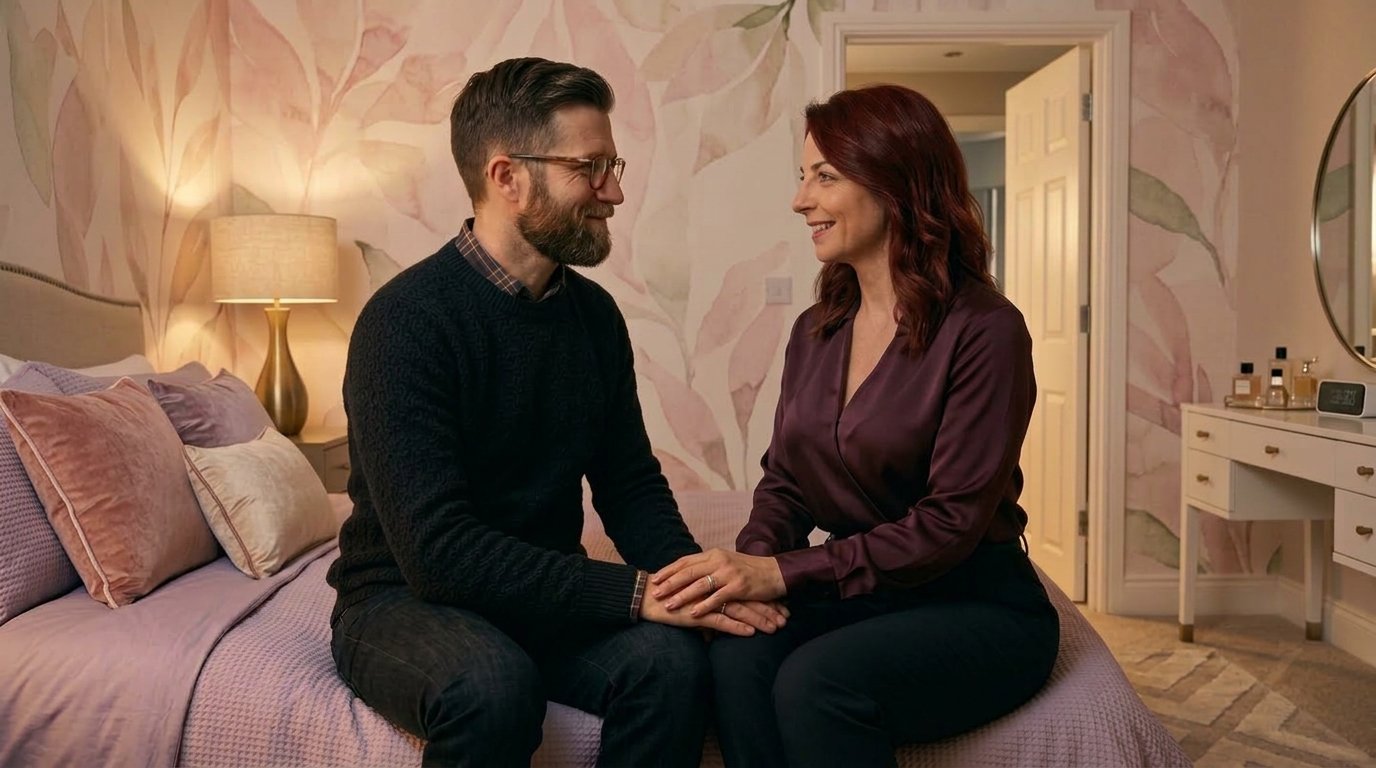
There is kind of conversation that contradicts the relationship expectations that many of us take for granted and it begins with a woman saying, “I love you, but I do not want intercourse with you to be an expectation anymore.” If you are the man hearing it, you might feel a dozen things at once. You may feel embarrassed, curious, relieved, scared, or suddenly very interested in whether she still wants you at all. If you are the woman saying it, you might be wondering how to make your needs clear without making the man you love feel disposable.
So what is your relationship evolving into? Pussy free? Pussy lite? This is where the distinction gets interesting. I use pussy lite to mean intercourse is still possible, but rare, conditional, or entirely at her discretion. Pussy free means intercourse between these two partners is off the table as an agreed part of their relationship. Neither label has an official rulebook, they are simply used to create clear set of rules that both of you agree to. What doesn’t matter is whether somebody on the internet thinks you are using the term correctly.
My possibly provocative opinion? If intercourse has become a recurring negotiation, a disappointment, or a quiet assumption she is tired of managing, pussy free may be kinder and sexier than pussy lite. Not for every couple. Not because intercourse is bad. But because a clear boundary can create room for a much better relationship than a perpetual “maybe.”
The Half Open Door
On paper, pussy lite sounds like the better compromise. She does not have to promise regular intercourse to him, and he does not have to imagine a relationship where sex disappears indefinitely. Everybody gets to breathe and it makes the conversation just a little bit easier.
Except sometimes nobody actually does breathe easier because if “occasionally” means it is up to her to decide whether she wants intercourse on any given night, that seems great. After all, it is true of every sexual activity, regardless of the relationship label. Each of you can always consent or un-consent to sex happening. But if “occasionally” becomes his reason to wonder whether tonight is finally the night, every kiss can acquire a second question. Every massage can begin to feel like a campaign of coercion. Every refusal can seem like a verdict and it can change the balance of the emotional relationship.
She may start monitoring his disappointment and feeling intense guilt instead of enjoying his attention. He may start searching for a formula for her affection and see sex as the object or goal. Was dinner romantic enough? Did he spend enough on the gift he gave her? Did he say the right thing? Has it been long enough? Suddenly the bedroom feels less like a place to connect and more like an application process where is he seeking validation from something that she may not be interested in.
That is not a complaint about a man having desire. I like desire. I married a man with feelings. This is a complaint about an unclear agreement creating pressure that neither partner intended. Pussy lite works beautifully when both people can enjoy what is available without treating intercourse as the prize. It works less beautifully when “lite” is really a polite name for a boundary one person is afraid to state and the other is afraid to hear.
Sometimes a man can feel sexually wanted because his wife keeps having intercourse with him, yet sense that she is doing it to protect their connection rather than because she wants that sexual experience. That can be a lonely kind of reassurance, it can feel inauthentic and empty. He gets sex but may find himself wondering whether she was excited or simply afraid that saying no would make him feel unloved. I think many men would rather hear an honest, tender truth than be given sex their partner feels she has to offer to keep the peace.
Being denied sex can feel like the opposite at first, but in a relationship where both people choose authenticity in their arrangement, it can protect that same connection more honestly. She no longer has to use her body as a tool to reassure him, and he no longer has to wonder whether her yes came from desire or obligation. He can still be wanted for his affection, his attention, emotional connection, his touch, and the life they share. The boundary may disappoint him but either it creates a place for something real, a closeness neither of them has to perform.
A Clear Message
A pussy free agreement answers one question before the evening even begins. Sexual intercourse between us is not happening and its not a reflection on the course of your performance this evening. Not because she owes him an explanation or because he needs to work harder or do better to earn it back. It is simply not part of this version of their relationship.
Now imagine what happens to a kiss when it does not have to lead anywhere. He can kiss her because he wants to kiss her not because he is trying to fire up her responsive desire. She can lean into him with her most passionate self without calculating whether he will mistake affection for an invitation. They can decide whether they want touch, pleasure, closeness, or just an early night without the same unresolved expectation hanging over them.
There is a difference between denying a man something as part of consensual erotic play and making him guess where the boundary is. The first can be delicious for people who want it. The second can become exhausting and a recipe for resentment. What I am not claiming is that a pussy free agreement automatically improves intimacy. There is no study I can reference that would say couples who choose this dynamic are happier or sadder. I am saying that clarity about sex removes a particular source of friction, and what a couple does with that clarity is up to them.
Ownership Of Her Body
Marriage does not mean that a woman’s body is her husband’s to use whenever he wishes. Yes, some men see it that way. He can want intercourse. He is allowed to miss sex, even mourn the loss of sex. He can tell her honestly that a proposed arrangement would not work for him and they can modify their agreement or choose to end their relationship. What he cannot do is turn commitment into a claim on her body. For some couples, saying “we are pussy free” makes that principle emotionally vivid. It is a continuing reminder that access is not built into the marriage. They are there because they choose each other, not because he wants some sort of implied privilege to her body.
In a female led relationship, that reminder can be thrilling and he can learn to find a genuine pleasure in respecting them. Men ard women are both entitled to say no to intercourse whether the other partner finds it sexy or not. A man is also entitled to be honest about whether he wants to stay in a relationship with that boundary. Consent is not improved by pretending either person’s feelings do not count. Both feelings count, and it isn’t to say “I’ve decided your feelings no longer matter.” Instead, it is “Here is what I want. Tell me honestly whether you want to build a life with me this way.”
Taking Intercourse Away
I sometimes wonder how many couples are having intercourse because they truly love it, and how many are doing it because they have never paused to ask what else counts as sex. After all for many women, pleasure is not focused around penetration. In fact, only 18.4% of women say that intercourse alone is sufficient for orgasm. Another 36.6 percent said clitoral stimulation was necessary during intercourse, while 36 percent said it made their orgasms feel better even when it was not necessary. Especially in the context of long term relationships, orgasms are often tied to newness and novelty, the more “the same” his penis feels, the less chance it will lead to an orgasm for her. These stats do not tell any individual woman what she should like but it does remind us that penetration is rarely the main event.
A pussy free marriage can absolutely include flirtation, kissing, oral pleasure, hands, toys, cuddling, sensual attention, and whatever else both people enjoy. It can leave space for his pleasure too. The boundary is about a specific act between specific people, not some sort of decision that he is no longer permitted to be a sexual human being. “You do not get to have intercourse with me” is a clear boundary. “You exist only to serve me and never get to have needs” is a very different proposition. Some people may enjoy playing with that language, but it should remain a mutually wanted game, not the price of being loved. For the right couple, the shift changes the question from “When will we have intercourse?” to “What feels good between us?” That is a much more interesting, and loving question.
Here is where pussy free conversations sometimes get uncomfortable. Maybe she loves penetration, but intercourse with him does not satisfy her the way she wants. It could be about size, stamina, the kind of touch she prefers, a mismatch in anatomy, or simply chemistry. It may have nothing to do with how much she loves him. It’s not necessarily that he’s bad in bed but they aren’t a match sexually and a pussy free dynamic names that rather than dancing around that truth.
A man can be wonderful in bed without being the person who gives her every kind of pleasure. A man can also be a loving, confident husband while acknowledging that what she wants from penetration is not something that works in a way that suits both of them. We do not need to turn every mismatch into an argument over whose body is defective.
Some couples enjoy giving that mismatch an erotic voice through small penis humiliation (SPH) and while it can seem harsh or mean, the appeal actually makes sense when a man genuinely wants that play. Eroticizing an otherwise tender subject can make it feel exciting, especially if he finds comfort in eroticizing the surrender of that role. It can be fun to find out which words he likes, which ones he does not, and whether he wants this to be part of your dynamic at all. Never assume that because he is submissive, he wants an insecurity brought into the bedroom. A good tease leaves him feeling known. A bad one leaves him feeling alone.
And if her pleasure is better met through manual stimulation rather than intercourse, he may be exactly the right partner to provide it. His role does not have to shrink. It can become more attentive, more skilled, and more connected to what she actually enjoys.
Denial Is Not a Mixed Message
When I talk about taking intercourse away, I don’t mean suddenly making him a sexual partner one night and a completely non-sexual partner the next with no explanation. That kind of back-and-forth can be confusing, especially if he is left wondering whether he is being punished, teased, or simply shut out.
Short term denial can be a fun and exciting part of foreplay and teasing but long term denial makes the most sense to him when it has a clear emotional and relationship reasoning. In a pussy-free marriage, he is denied penetrative access because traditional intercourse is no longer meeting her needs. That does not mean he is unloved, unwanted, or excluded from intimacy because that is where his mind would automatically go. It means his role in the sexual relationship has changed in a very deliberate way. Unless she initiates a conversation about changing that arrangement, he should understand that she no longer chooses him as a penetrative sexual partner. His role is not “no sex” it is a different kind of sex.
For some couples, he may become a receptive partner. Pegging, chastity, prostate play, massage, erotic service, and other forms of intimacy can become central to their sexual connection. He can still be involved, still desired, and still deeply connected, but the expectation that sex must end with him inside her is removed. That shift creates room for you to decide what you actually want. A relationship structure that allows you to prioritize your needs? Can you imagine that?
She may choose to have her penetrative needs met elsewhere, or she may decide that penetrative sex is not something she wants at all. Either way, her decision does not need to be treated as a temporary problem for him to solve. It is a boundary and relationship structure that should remain in place unless she chooses to revisit it through a direct conversation. Neither choice requires guilt or an apology. The important part is that she is honest about the structure she is creating and does not pretend that denial is temporary if she knows it is becoming a long-term part of their dynamic.
His sexual participation can also take many forms that focus on her pleasure without bringing traditional intercourse back to the table. He may be asked to please her with toys, oral sex, hands, massage, or acts of service. The key is to create an understanding of what their new definition of what sex looks like. The key is in that clarity, he should understand that he is not being denied because he has failed a test or because she is carelessly changing the rules to punish him. This is about her needs and he is being denied because she is choosing a relationship structure that better reflects her changing desires, and boundaries. Once that baseline is understood, denial stops feeling like a confusing absence and starts becoming a deliberate way of redefining intimacy together.
His Role Shouldn’t Be Confusing
When traditional intercourse is removed from the equation, his sexual role may change too but that shift should be discussed clearly and openly. This is especially important if he previously understood that penetrative sex was an important part of his place in the relationship. He should not be left trying to decode whether he is being punished, teased, or permanently demoted to a different kind of sexual role.
If intercourse stopped because it was not satisfying for her, clear definition into that reason still matters. Maybe penetration with him did not give her the physical pleasure she needed. Maybe his stamina, technique, size, chemistry, or approach to her pleasure left her consistently unfulfilled. Maybe she realized she prefers other types of stimulation from him. Maybe she wants a more dominant dynamic, or simply no longer gets what she needs from penetrative sex with him.
But if she later wants to bring intercourse back, it is fair for both of them to talk about what has actually changed. Has he become more attentive and skilled? Have their sexual needs evolved to where she wants intercourse to be back on the table? She should never feel obligated to go backward into sex that did not fulfill her just to meet a obligation stemming from relationship guilt. At the same time, he deserves enough honesty to understand whether intercourse is genuinely returning, whether it is an occasional exception, or whether his role is still centered elsewhere.
For many couples, his new role is not “no sex.” It is a different kind of sex. He may be a receptive partner through pegging, chastity, teasing, or reverse pegging. He may be asked to focus his sexual energy on her pleasure through toys, oral sex, massage, and erotic service. She may choose to have her penetrative needs met elsewhere, or she may decide that penetration is simply not what she wants at this stage of her life. The goal is not to make him feel replaceable or keep him guessing. The goal is to create a sexual structure that reflects what genuinely works for her while giving both partners a clear and honest understanding of their agreed sexual structure.
This isn’t to say he has to smile, nod, and accept a dynamic that no longer works for him. I can set a sexual boundary around my body and the kind of access that I give him, but he still gets to decide what that means for him. He can embrace the arrangement, tell me what he needs in order to feel loved and connected, set boundaries of his own, or be honest that this is a bigger relationship conversation. I’m not asking him to erase his needs just because I’ve become clearer about mine. The point is not that one person wins and the other quietly settles; it is that we both get honest about what we want, what we can give, and whether we can create a relationship that feels good for both of us.
She May Still Want Penetration
Pussy free describes what happens between her and her husband. It does not necessarily describe everything she wants for her own sex life. This is where some couples discuss the possibility of other partners. If she enjoys penetration but does not want it with her husband, she might seek that pleasure elsewhere, provided of course that everyone is on board. In some relationships that becomes a cuckold dynamic and in others it can be a type of nonmonogamy. And plenty of couples do neither.
I wouldn’t say that pussy lite and pussy free relationships are destined to progress to cuckolding. Sometimes they can and it would make sense if she has a desire for penetrative sex. In my life, Kev and I have our own way of navigating marriage, and Erik is part of that story. But I would never hand our arrangement to another couple and call it some sort of inevitability. What feels affectionate and freeing to us would be completely wrong for people who do not genuinely want it.
For some pussy free couples, a cuckold dynamic can be unexpectedly cathartic. If he wants to witness it, seeing her with a lover can bring into focus something they have struggled to say aloud. Her desire feels different in that sexual dynamic than it did during intercourse with him. The comparison may sting, and for a man who enjoys that edge, it may also be thrilling to know he is enabling her to feel a more authentic type of pleasure. But the real relief comes afterward, when neither of them has to pretend they saw something else. She can be honest about what excites her, and he can know that being her husband still means being the person she trusts with that honesty. This only works when he wants to see it, her lover agrees, and they can have honest conversations about what feelings were brought up once the excitement fades.
If another partner does become part of the picture, the conversation has to be bigger than “She wants penetration, so let’s find a man.” Talk about sexual health, privacy, time, feelings, what each person wants to know, and whether the husband wants to watch, hear about it afterward, participate in some other way, or stay completely outside that part of her life. It is important that the other partner be treated as a person with boundaries, too, not a prop brought or sex toy for the marriage.
Studies show that many couples who practice consensual nonmonogamy feel every bit as happy as couples who are monogamous. That is encouragement to make a thoughtful agreement but not a promise that opening a relationship will fix one that is already broken or hurting.
Love Through Erotic Humiliation
For some couples, the emotional charge comes from a contrast of being deeply loved, yet he does not have this particular access to her body. She may tease him about it. He may enjoy knowing she seeks a kind of pleasure elsewhere especially when it is with men who are vastly difference than him due to size, build, age or other traits. He might even enjoy supporting her before a date, giving her aftercare or cleanup afterwards or simply hearing that she had a wonderful time.
You can see why it might be powerful, there is something intimate about trusting your partner with a desire that makes him feel deeply vulnerable. A man who likes being called inadequate during times of play does not necessarily believe he is inadequate as a husband. A woman who enjoys asserting sexual control does not necessarily want to manage every detail of their lives. The fantasy has room to be provocative precisely because the relationship underneath it is secure.
Pussy Free For Pain Not Power
There is another reason I refuse to treat cuckolding as the expected destination, sometimes a woman does not want intercourse because it hurts. Endometriosis is one possible and very common cause of painful sex, and its effects can reach well beyond the moment of intercourse. Some women with endometriosis report cringing when their husbands touch them because it reminds them of pain they experience during sex.
A pussy free boundary might give a woman with pain the chance to relax with her partner once again. She may want tenderness, pleasure in ways that feel comfortable, or simply the freedom to cuddle without bracing for a painful suggestion. Her husband may feel relieved to stop worrying that intimacy means asking her to endure something. That can be a deeply loving change, with no third person anywhere in the story. There is room for medical care and a sexual boundary at the same time and seeking help for pain does not obligate her to put intercourse back on the menu.
Having The Conversation
I would not start by announcing a permanent rule in the middle of an argument. I would choose a calm moment and speak like a woman talking to a man she loves. “I love our connection, but I have realized intercourse between us is something I do not want to keep negotiating. I would like to take it off the table and talk about what intimacy could look like instead. I want to know how that feels to you.”
That is direct. It does not apologize for her boundary, and it does not presume his answer. Then I would get specific. Does pussy free mean no intercourse indefinitely, or are they trying it for a defined period and checking in? What kinds of touch do they both still want? Is this a private shift between the two of them or is this a discussion that may lead to a conversation about nonmonogamy? Is denial part of the excitement, or would that make one of them feel pressured? What happens when somebody feels sad, frustrated, or upset? I would also leave space for the least sexy sentence in the world, a question that is often the most useful: “I need time to think.”
He does not have to produce a delighted response on cue. She does not have to soften her no while he thinks. They can care about each other and still recognize that this is a meaningful change that might need some time to process. If pussy lite has been working, there is no trophy for replacing it with pussy free. But if it has become an endless audition for an act she does not really want with him, I would stop calling the lack of clear definition a compromise. A pussy free agreement might give them the clarity the need to love each other more deeply.
What I like about pussy free is not the idea of a husband being reduced. It is the possibility that a couple could become more honest about what each person brings to the relationship. She gets to say, “This is my body, and this is what I want.” He gets to say, “Here is how I feel, and here is what I can lovingly choose.” They can build a sex life around the pleasure that is real for them rather than the performance they think marriage requires.
Maybe that includes playful denial and a very blush worthy conversation after she spends an evening with a lover. Maybe it includes a husband who knows exactly how she likes to be touched. Maybe it includes two people managing pain gently, making dinner, and falling asleep close together. There is no right answer and none of those marriages is automatically more evolved than another.
Pussy lite leaves the door open, and for some couples that is perfect. Pussy free closes one door on purpose. Sometimes the surprising part is how much more comfortably they can stand beside each other once they stop waiting for it to open.
Evolving the Conversation
- If intercourse disappeared from your relationship, which kinds of intimacy would you most want to keep?
- Does pussy lite feel flexible to you, or does it create an expectation you would rather resolve?
- What would help a man feel loved and valued while his role in the relationship changes?
- Where is the line between loving humiliation and a comment that genuinely hurts?
- Could a pussy free agreement stand on its own for you, or would you want to discuss other partners?

And women wonder why they keep getting cheated on. When sex is a need, which it is for the vast majority of men, and you close the door on it, make sure there is a mirror nearby when you start to ask why when your husband becomes distant and hides their phone from you. It doesn’t take much time for that cute 25yr old woman that he met while getting coffee to to be very appealing. FLR or not, chastity or not, actions have consequences.
If a guy is unhappy with the sexual structure of his marriage, he has options. He can talk to his wife, say that the arrangement no longer works for him, set a boundary of his own, or even decide the relationship is not right for him anymore. My point is about women being allowed to set their own boundaries and not feel like they are obligated to be the source of the sexual needs. We can be creative in deciding how we meet those needs together.
But you didn’t decide together. In this scenario, the woman decided unilaterally, which is her right, but it doesn’t come without cost. Any scrolling through social media shows women unable to come to terms with the fact that her husband had an affair after not having sex for months or years, not because of medical reasons, but because of whimsy or the sudden desire to “find herself” or to weaponize an integral part of marriage. Then these same women try to capitalize on telling their sob story to anyone who will listen, completely unaware that she played a hand in how their relationship took a nose dive.
Also, the husband doesn’t have as many options as you might think. Cheaper to keep her isn’t just a witty catch phrase. It was born from lived experience. Divorce courts, like family court, are intentionally weighted toward women, and men are forced to deal with the decision of staying in a sexless marriage, or forking over half their retirement plus alimony. No matter how you spin it, I’d hardly call that intimacy.
In the end, all I’m saying is if you want an emotionally checked out husband who has suddenly found himself in a position where he’s considering doing something he never thought he would, then by all means, make sex with you an unattainable thing.
You know I read everything you sead and can’t argue with the logic at all …..
And I can also flip it so people can see it different flip the genders…..
Suddenly if it’s the wife being held in a sexless marriage she didn’t want or ask for ….. Do’s that not go against 90% of what Emma writes about? ….. Hmmmm 🤔 just my thoughts 🤔
‘A clear boundary can create room for a much better relationship than a perpetual “maybe.”’
I think for many couples, particularly in long-term relationships, this can be a very positive and liberating conversation to have. First off, discussing what works and what doesn’t can lead to more of what works!
It can also be the best opportunity to bring the husband’s masturbation out into the open. Perhaps she acknowledges his lack of traditional sexual opportunity and can encourage him to take matters into his own hands, so to speak.
Setting guidelines for his solo play – when it is allowed, when it isn’t, etc, brings an important element of his sexuality back to the marriage, rather than being furtive and hidden from her.
When my wife and I are home, I’m generally on ‘honor system’ chastity. I can pleasure myself, but not to full release. When she travels, however, I’m permitted much more freedom of ejaculation. (And she doesn’t have to feel bad for me, home all alone…)
It certainly has been a fun development for both of us – and she’s bought me ‘toys’ for my enjoyment – another way of bringing male masturbation back to the marriage.
I completely agree that nobody has a right to decide over another person’s body, unless somebody handed this right to someone else in a consensual power exchange. Therefore I completely agree that every woman has the right to decide that her pussy is off limits for her husband. I would understand this decision under two circumstances: if she is suffering pain from PIV sex, it is absolutely clear that hurtful sex, which penetrative sex is in this case, is completely off the table. For my understanding, the same is true if she has repeteadly been pressured or coerced into PIV sex. In these two cases I would absolutely go with her decision for “pussy free”. On the flip side, if these two conditions are not given, and out of the blue she decides, bluntly saying, “I forbid you any more PIV sex because I don’t crave you any more, but I want to keep you as an emotional anchor and as a provider and supplier. Instead of sex with you, I crave PIV-sex with other men that are better than you. You are not good enough for me!” My personal reaction would be: “I completely understand your decision, and I will respect it and never again try to have PIV-sex with you. Furthermore, I understand this as your first decision of a multi-stage decision process, where the next steps will be: touching of pussy and boobs with hands or mouth are forbidden, then kissing will be wiped off the table, and finally any physical touch of arms, cheeks or back, as any physical closeness with me is obviously disgusting for you. A mere emotional connection and a role as provider is not enough for me, I don’t want to end in a completely dead bedroom-relationship, while in the same time your sex life with your bulls skyrockets. So I think it is best for both of us not to lose any time. Go ahead and find happiness with other, better men, while I will search my happiness with a woman who appreciates me as the man I am, and not only the emotional and providing side of me. Farewell!”
Hi. I’ve been lurking this blog for a while now, and just registered specifically to respond to this post.
I must say, the idea of a pussy-free marriage based on the wife no longer desiring intercourse with her husband *at all* seems sad to me. Particularly if she does desire intercourse but never with *him* again, I believe ‘pussy-free’ is likely to be far more of a problem than a solution to anything.
However, that is not really what I came here to speak to. No, I’m here about the endo. My wife had endo for much of her adult life, until a hysterectomy eventually dealt with that. This began decades ago, when endo was not widely known, and it was a painstaking drawn-out process even to get a diagnosis. Also, she had related other conditions that meant periodic abdominal surgeries, which of course caused their own knock-on effects.
As you can imagine, sex was problematic. There were spells when it was possible, even joyful, and periods, sometimes long ones, when it was out of the question. During the good times, she appreciated my stamina (her first husband had had a PE issue which had frustrated her). During the so-so times, she could make it to orgasm but I would generally have to stop without getting my turn. I went down on her a lot, and that was sometimes the only option, although during the roughest spells she didn’t really want anything going on ‘down there.’ Not even that.
None of that was any kind of FLR kink. Lots of oral service, me withdrawing without orgasm: it wasn’t kink, it wasn’t some FLR power dynamic, it was just navigating the sexual aspects of a difficult and painful chronic illness together. Do we have an FLR at all? I’m still not sure. Certainly nothing declared, and nothing with kink. Yet sort of. She is the more assertive. Demanding, even. I am the breadwinner and also do much of the domestic service: a situation I am content with, and which my work has allowed much of the time. What is that, Level 1? Level 0? I came curious to find out and I still don’t know. But based on my experience, I think you definitely *could* cope with endo using an FLR dynamic.
One thing I found refreshing in this post was that, at least in the section on pain, cuckolding was *not* recommended! Yay! So often it seems to be the prescription for everything here! But yeah, in this case, definitely not. My wife would certainly not have wanted anyone bigger. Ouch. Smaller, maybe. I suppose she could have cuckolded me with a ‘Bull’ with a tiny dick. “Oh look honey, see how I can barely feel him inside me? This is what I need! Don’t you wish you were him?” Haha. An odd twist on the cuckold dynamic for sure. But I am joking of course, when the endo is bad, size really doesn’t matter. Even a tiny Bull would be a no.
I suppose on the contrary, I could have framed her endo as a sexual shortcoming, analogous to small penis size in a man, and demanded that she accept my opening my side of the marriage and fucking other women to achieve my satisfaction. Or simply cheated. But the idea did not occur to me, and I did not do any such thing. I love my wife, and that would have felt, and would have been, unbelievably cruel. No, we just navigated the problem as best we could together without introducing anyone else. It was not easy. It hasn’t all been sunshine and light. Endo is corrosive when it comes to sex in a marriage. But, our next anniversary will be our 40th, so we’ve managed so far.
Thank you for registering and for following the blog for so long. Of course there are concerns with a marriage where the woman doesn’t want traditional sex with her husband – especially when she may want it elsewhere. It’s a complex issue and all to common. Pussy lite, pussy free, divorce, separation, couples therapy, sex therapy… let’s be real about all of the options especially when the rest of the relationship is sunshine and roses. I talk about all sorts of modern marriage dynamics to help especially when all the cards are on the table and both people aren’t afraid to have a honest conversation about needs and desires.
I’m sorry your wife had to wait so long for an endometriosis diagnosis, then deal with surgeries on top of it. A chronic illness can change sex without changing the love between two people. And you’re absolutely right, caring for her, giving pleasure when she wanted it, or going without your own needs didn’t make it a kink.
I wouldn’t worry too much about whether your marriage qualifies as “Level 0” or “Level 1,” either. An FLR can be a useful way for couples to take on new structure but you don’t need a label to define which aspects are helpful and which might be hurtful.
I want to call out what you said about not treating her illness as a shortcoming or using it to justify cheating or demanding an open marriage. You agreed to love each other through the easy times and the hard times and that doesn’t mean the difficult years were a walk in the park for you. You faced challenges as partners and worked together through it. That’s what I hope this blog is all about, I try to throw all the ideas out there and hope that couples can work together to see which goldilocks modern marriage dynamics work for them (this is too much, this isn’t enough, this is juuuuuust right).
Anyway, thanks for commenting and I wish you both a wonderful 40th. ❤️
We had a similar situation my wife got sick for about 3 years couldn’t do anything comfortable with sex ……. Even though I have a open door 🚪 I shut it if she couldn’t I wouldn’t….. When she was pregnant anything she couldn’t do I wouldn’t…. That I already believe is the way a marriage should be but that’s my belief I won’t force it on anyone
I live my life in a way where I never expect any person/place/ or thing to ever feel obligated to me in any way. I always want it to be a choice and if the answer isn’t an emphatic yes, it is a no for me. Be it a person, job or whatever else, I don’t even want a tepid yes or I am not sure. I don’t get upset or anything and I wish them well but I only want to devote my time to yes energy. In that sense, this article is not for me but I get it. The thing is though that the kind of man you are talking about here, the one who expects sex as an obligation, would never agree or be open to this. I just think back to all the conversations about when my gf was married. How it was her job to take care of the house, the kids, maintain a level of attractiveness and provide sex to her husband. Failing to do so would justify an affair or divorce. As odd as it may seem, it did work on a functional level. All her kids turned out great because they had a loving mother present everyday growing up but it was miserable marriage with a lot of fighting and it scrambled her brain in a lot of ways. In how she thinks of herself and such. She never heard of cuckolding and she laughs so much at the thought of going back in time to propose cuckolding to him as a way to help the marriage. She says it would end like OJ Simpson though with him killing her and anybody he thought was her bull.
5 days earlier this would have been a lovely addition to the Locktober introduction. “Honey, for the next month I want us to experience a pussyfree relationship, between us no vaginal sex, and I think a chastity cage will help, are you willing to go through Locktober? it could be a real eye opener for what sex means to us, and how you connect with me. to be fair, I said between us, I’m still visiting my old friend once in a while, I’ll still bring home cream pie for you.” — wait, is oral allowed in pussyfree context?