

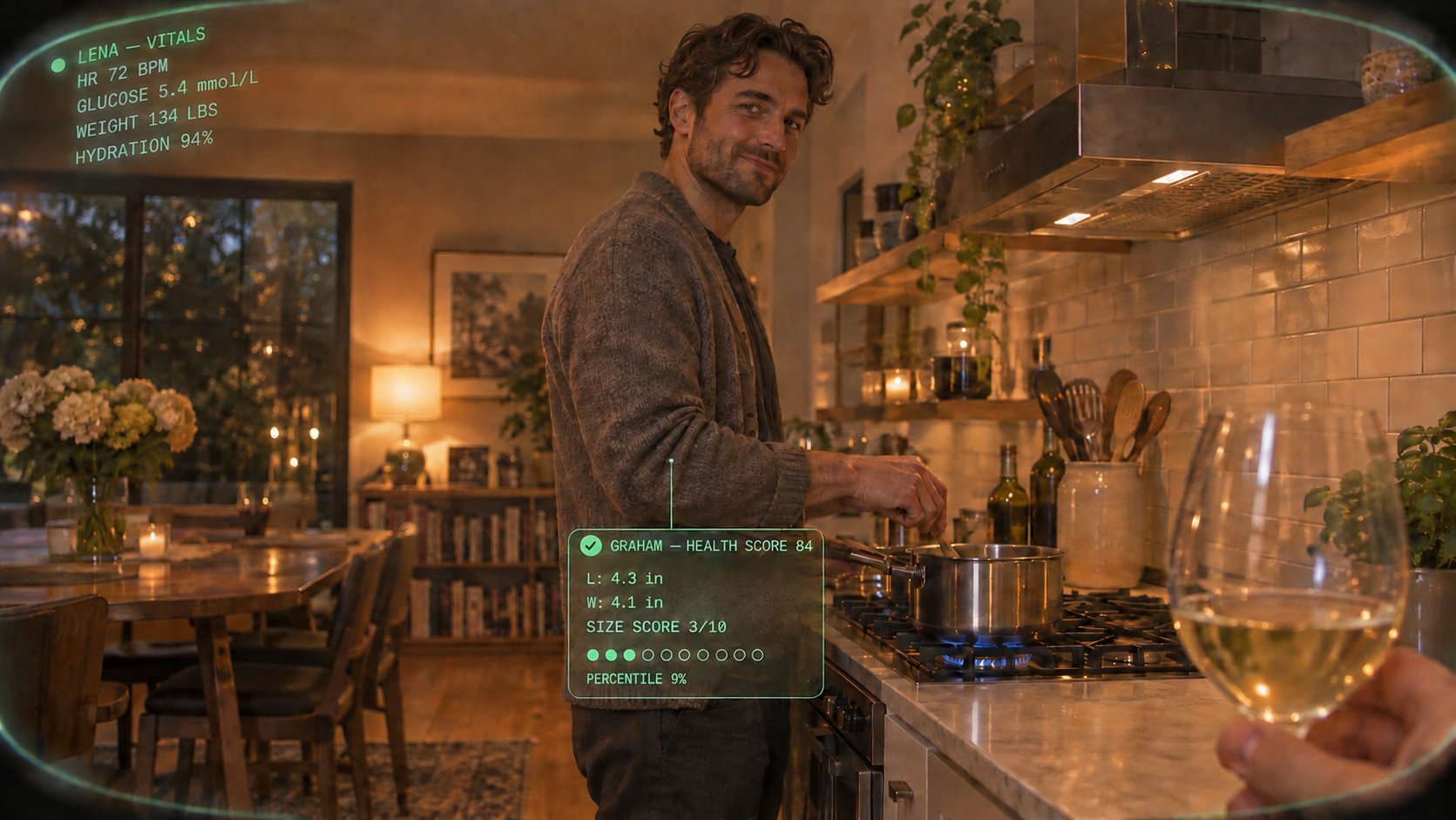
The first thing you should know about the Toggle is that nobody voted on it. There was no law, no referendum, no marketing campaign with a catchy name. One Tuesday in March, a medical data conglomerate lost forty million patient files to a breach, it was the biggest in history, though records stopped being the story within a week. By that Friday, the AR lens companies had simply… enabled an option. An opt-in, they called it, the way you’d describe a small setting in your heads-up mode. A small switch in your settings menu, right between color correction and captioning: Endowment View.
You look at a man, and there it is. A discreet teal readout floating at chest height, just above his beltline. Two numbers, length and circumference, certified against his most recent physical. His actual measurements, gathered by an actual doctor, rendered in clean sans-serif like the weather.
They can’t show you anything about his heart, mind you. Whether he’s kind. Whether he laughs at your jokes or just near them. Whether he calls his mother. The Toggle shows you exactly one true thing about a man and nothing else, and it turns out one true thing was all we ever needed to reorganize the entire world.
My name is Lena. I’m thirty-four, I work in brand design, and I’ve been married for six years to a wonderful man named Graham who is four point three inches erect. You know that now, the same way everyone knows it — I didn’t have to tell you, and I didn’t have to choose to. It’s simply in the air around him, the way his cologne is, the way his terrible puns are. And I’m going to tell you what it’s like to love a man the whole world can measure his sexual value at a glance, because I think somebody should, and because most of what gets written about the Toggle is written by people who have never lived on the small side of it.
I want to explain the mechanics first, matter-of-factly, because the mechanics matter — and then I want to tell you about the dinner party, which is really what this story is about.
The breach dumped the urological measurements of roughly two-thirds of adult men into the open. Not all men. That detail turns out to be load-bearing. The men whose data escaped — and eventually that was most of them, because medical data is copied the way water runs downhill — woke up one morning to find their most private arithmetic floating above their heads for anyone with a lens subscription. The AR companies swore up and down they were horrified but the user options allowed literally anyone to plug data into the displays so within a month every major lens manufacturer had the option.
The numbers come from recent medical exams, which means they’re accurate and they’re current. A man who loses weight sees his readout change. A man on certain medications sees it change. It is, in the purest sense, the most honest thing about him, and it updates automatically.
The dating apps were next, and honestly, the apps didn’t even have to be clever about it. Men’s leaked measurements simply matched to their profiles and the apps called it “compatibility data,” which is a phrase that was vague enough and within a year, the filter was as standard as age and distance. You could set a filter for minimum and maximum, many women did. I did, for a while, back when I still thought of it the way everyone thought of it, a time-saver. Why waste a first date discovering a dealbreaker when the dealbreaker could be displayed in teal serif font before he even said hello?
The men, meanwhile and this is the part nobody predicted — toggled it on themselves. Most men, when surveyed, keep Endowment View switched on. More information is better, was the general consensus. It’s a strange kind of courage, or a strange kind of surrender, and I’ve stopped being able to tell the difference. Men look at each other’s numbers constantly. At the gym. In meetings. Across the urinal dividers, which took on a certain cold war quality. A man knows his boss’s number, his brother-in-law’s number, his barber’s number. There’s a whole quiet etiquette about it, the way there was once an etiquette about not mentioning someone’s salary. It’s rude to reference the number directly. It’s ruder not to have looked.
And then there’s going dark.
Some men’s data never leaked. A smaller number refused to publish it. And the world decided, collectively and without a single meeting, that this was worse. A man with no readout walks around with a blank space where his truth should be, and the blank space is loud. It says: I have something to hide. It says: ask yourselves what. The speculation is always crueler than the truth, which is why most unlisted men eventually publish their own numbers themselves, self-reported, it lacks the little certified symbol but otherwise the same because once the world knows you’re hiding, a curated honesty is the only dignified exit. My husband’s colleague Rob went dark for eight months. He lost his softball league, his poker night, and eventually his job, though the job loss was officially about “culture fit.” He’s self-published now, 5.1 and trying to make it a personality. I think about Rob more than I should.
So that’s the machine. A leak, a toggle, a filter, and a social order that grew around them the way coral grows around a shipwreck. Nothing about it was ever made illegal, because nothing about it was ever really new. It was only the oldest thing in the world, just a way we sort and filter each other but this time with a user interface.
Here’s what the machine did to love, or at least to my love.
I met Graham three years after the Toggle went live, which means I knew his number before I knew his middle name. 4.3 inches length and 4.1 inches girth. The readout hovered over his head at a friend’s housewarming like a price tag on something I hadn’t asked to price. I remember being grateful, in a numb kind of way, that I didn’t have to do the math later — the slow arithmetic women used to do in the dark, recalibrating hope against reality. The Toggle took the mystery out. What nobody tells you is what it puts in instead, which is the requirement to decide, with your whole self and in advance, what a man is worth to you.
That’s the honest description. Everything else is euphemism.
The apps called men like Graham “devotion matches.” There was even a little icon for it, a heart with a checkmark and the algorithm, in its blunt genius, was not wrong about the matching, only about the naming. Because here’s what actually happened to the dating economy when the numbers went public, the sorting stopped pretending to be about anything else. Tall men got filtered for first dates. Large men got filtered for everything else. And small or average men, the Grahams of the world got filtered for partnership. For marriage. For the long, durable, unglamorous architecture of a life, someone who pays the bills, reminds you of your bestie’s birthday, who handles the insurance calls, who learns exactly how you take your coffee and then makes it for you for thirty years.
Women still wanted to marry small men and that surprised people. It shouldn’t have. Marrying for devotion is the oldest institution we have, they have something to prove and they are constantly trying to prove they measure up. The toggle showed just how much they had to prove, it used to require a certain amount of not-knowing. The Toggle removed the not-knowing and left the institution standing, which tells you the institution was never really built on ignorance. It was built on the understanding that a marriage and a fantasy are different purchases. You marry the man. You do not have to marry the fantasy. The fantasy, in this world, has become something you keep beside the marriage, the way you’d keep a garden or a wine cellar, and I’ll get to mine.
I’m getting ahead of myself. Graham, first.
At that housewarming, he was the one refilling everyone’s drinks and pretending not to know the numbers floating over every head in the room, including his own. He’s thirty-six. He cooks like it’s a love language — because it is — and he tells jokes that are bad in a way I find genuinely addictive. He was the last person at the party still helping stack chairs. I toggled my view off when I talked to him, the way you’d take off sunglasses indoors. It felt like a courtesy. Then it felt like something else, something I didn’t have a word for until much later: it felt like meeting him.
I’m not going to romanticize it into destiny. I’m going to tell it straight, the way this world has taught me to tell everything. I ran the numbers. I knew what 4.3 meant for me, for the specific geometry of my own body and my own history, and I decided — with the full spreadsheet open, which is the only way anyone decides anything now — that the rest of my life with this man was worth more than that particular type of pleasure. I chose him with my eyes open. If the Toggle has given me one gift, it’s that phrase. I can say I chose him with my eyes open and there is a strange, hard dignity in that. Nobody chose anything with open eyes before. Our wedding was small and perfect. The bridal shower, though — the bridal shower is where I first understood what I’d signed up for, socially speaking.
You need to understand the shame economy before I can tell you about the dinner party. Marrying small in this world is what marrying poor used to be. Not tragic, nobody’s cruel enough for tragic but quietly discounted. A small dowry. It changes how people hold their faces around you. At my shower, a well-meaning aunt pulled my mother aside — she thought I couldn’t hear, and I could — and said, in the tone you’d use for a diagnosis, “Well. He seems very devoted.” As if devotion were the consolation prize. As if I’d been given the news and this was us all coping.
My friends were kinder and worse. My friend Dana, three drinks in at the bachelorette, put her hand on my knee and said, “You know it’s not forever, right? Like — the arrangement. You can always have both.” And I said, “I know,” and she looked so relieved that I understood, for the first time, that my marriage had been quietly recategorized in her mind as a kind of noble hardship. Like adopting a rescue dog. Something you do out of goodness, and everyone admires you for, and nobody quite wants for themselves.
And the women who married large — or who date large, which in this world is its own status symbol — they don’t have it easy either, which I think is the machine’s cruelest joke. A woman on the arm of a man with an 8 over his head gets the ire of both camps. The women look at her the way people look at someone who married money: some envy, a lot of judgment, a running audit of whether she deserves it. The men look at her and see either a trophy to be poached or a warning label — size queen, they call it, and they mean it as a wound. A woman who openly prefers large men is treated the way men used to treat women who’d had “too many” partners. The double standard didn’t die; it just changed.
Last spring, a Saturday brunch, six of us on a patio with our glasses on dimming mode, because that’s just what sunglasses are now. And my friend Melanie — new to the group, not unkind, just unwashed in the etiquette — was telling a story about her sister’s new boyfriend, and she said, breezily, the way you’d mention someone’s job: “Well, he’s an eight, so, you know. She’s glowing.” And then she looked around the table and realized she’d said it in front of me, in front of my marriage, which everyone at that table could see rendered in teal font whenever they pleased. There was one of those silences, small, maybe two seconds, the silence of six women doing arithmetic about someone’s life at a brunch table.
And I felt it rise up in me, the old thing, the hot-eared thing, the flicker of humiliation on Graham’s behalf, on mine. And then I felt the other thing, the thing this world has taught me like a muscle. I picked up my mimosa and I said, “Good for her. Cole’s an 8.2, so I know the glow.” And the table exhaled. Literally, I watched six shoulders drop half an inch. Because that’s what the number of your boyfriend does in this world, when you’re a woman who married small. It’s not a confession and it’s not a boast. It’s a receipt. It’s you showing the room that the arithmetic of your life balances, that the devotion came with the fire attached, that nobody needs to feel sorry for you over eggs benedict. Melanie laughed and said, “More than compensates, honestly,” and everyone toasted that, and the story moved on, and my marriage was, for the rest of that brunch, a settled account.
More than compensates. I didn’t invent that phrase; it’s practically scripture now. And I want you to notice what it costs, because it does cost. It costs Graham something, that his wife carries his deficit around like a balance she publicly offsets. He’s never once asked me to stop. He knows, I think — he’s never said it in words and neither have I — that the alternative is the pity. He’d rather be the man whose wife glows elsewhere than the man whose wife is pitied by her friends. If that’s a wound, then it’s a wound he chose with his eyes open too, and there is a version of love in that so particular and so private that I’ve stopped expecting the outside world to price it correctly.
So women like me — and there are so many of us now, a whole quiet demographic the sociologists keep writing papers about — we’ve built a third path, and the world has mostly stopped pretending it doesn’t exist. You marry your devotion match. And you augment as needed.
That’s the word the sociologists use, I swear to you. Augment. As if my boyfriend were a vitamin regimen. The idea is that needing a larger partner to complete a smaller marriage is no longer an affair or a scandal or a kink — it’s maintenance. It’s the honest, boring infrastructure of a life, like a second car or a gym membership. If all your friends can see your husband’s number every time they look at him, and they can, they all can. Your boyfriend’s number does the talking. And your friends can relax, because the books of your life are publicly balanced, and nobody has to wonder whether you’re suffering.
I’m making it sound cold. It’s the coldest true thing I know, and it’s also, somehow, the warmest thing in my life, and I’ve given up on resolving that contradiction. I’ll just show you both sides and let you keep what you need.
Cole is thirty-one. He’s 8.2 erect, and he knows that number the way he knows his own name, because he’s been reading it over his own head since he was twenty-two. People see his number an smile knowingly and he’s grown accustomed to those smiles. I met him on an app, everyone assumes the number is the whole story of a man like Cole, the same way everyone assumed devotion was the whole story of a man like Graham. The number is the least interesting thing about him. He restores old motorcycles. He’s terrible at texting. He listens the way people listened before phones, he leans in with his full body and faces you while you talk. What the world sees when it sees us together is a correction. A wife stepping out, a husband staying home, the readouts explaining everything in that teal font, no further questions. What’s actually happening is something the readouts can’t render, an arrangement three people agreed to.
Because here’s the part the sociologists don’t put in the papers. Graham isn’t home tolerating my arrangement. Graham is home in it. When I dress for a date with Cole, my husband is the one who tells me the green dress or the black one, and he means it, and there is something in his eyes when he says it that I spent two years learning to name. It’s not resignation. It’s closer to what a man looks like when he’s doing the thing he was built for. The world would call it humiliation, and I suppose by the old dictionary it is. But I’ve watched this man be praised by his bosses and ignored by his bosses and passed over by his bosses, and I can tell you that the hours of his life that have the most color in them are the ones arranged around my evenings out. He waits up. Not because I ask him to. Because the waiting is the point. When I come home, he wants the whole story — every detail, every texture, told while he holds my hand like it’s the last piece of luggage off a plane. And then he wants to reclaim what’s his, in his way, with his four point three inches and his whole heart, and I will tell you plainly, since this whole world has stripped me of the option of pretending: no one on this earth has ever made me feel more loved than that man does in those hours. Cole takes me. Graham keeps me. The Toggle can display a lot of things. It cannot display that.
Shameful, you’re thinking. Isn’t it shameful for him? And yes, yes, it is, and I won’t sand that off to make this pretty. The shame is real and it’s daily and it isn’t ours alone. The shame is the weather this world makes all small men live in. Graham feels it at the grocery store, at the gym, in every meeting where he’s watched a readout over a younger man’s head and watched that man get promoted over him. The shame was handed to him by genetics and highlighted by a data breach and a settings menu. He has two choices about what to do with it, the same two choices every man in his percentile got. He could go dark and let the speculation eat him alive. Or he could stand in the middle of the blast radius with his number over his head and decide, daily, that it was one true thing about him and not the true thing.
He chose the second one. He chose it before he met me. It’s the bravest thing about him, braver than anything the readout could ever measure, and there is no settings menu on earth that will display it.
Now the dinner party. I’ve been circling it the way you circle the thing a story is actually about.
We host. It’s a holdover from before the Toggle, when having people over was how you learned them. Six guests, one Saturday in October. Dana and her husband, Mark, who’s 5.5 and sensitive about it, which in this world is a full personality. Priya and her wife, who don’t toggle at all, they say it’s the last unmediated room in their lives, and I love them for it. And my colleague Ben and his girlfriend, on their fourth date, which in this economy of ours is basically an engagement.
I cooked nothing. Graham cooked everything, the short rib, the polenta, the little caramelized fennel thing. He does this thing where he refuses help in his own kitchen, and the whole evening has the shape of a man performing his devotion for a room full of people who can see his number floating over the stove hood. I watched a few of them toggle on when they thought I wasn’t looking. You get a feel for it, the tiny flicker in someone’s eyes, the refocus and adjustment in their posture, the way you’d straighten up after checking a price. I don’t begrudge it anymore. It’s not cruelty. It’s just the machine’s native gesture, the checking, and everybody does it the way everybody once checked phones at dinner.
The evening was good. I want that on the record, because what happened later sits differently if you think the night was a failure. It wasn’t. The night was warm and loud and full of second helpings. Graham held court over dessert with a story about a raccoon and our dog that I’ve heard eleven times and laughed at like it was new, because when he tells it, it is.
Here’s the thing about that night I haven’t told you yet, I never once talked about Cole.
He came up, the way he always comes up, Mark made a joke about “the famous boyfriend” when the second bottle opened, and someone laughed, and I felt the table do its little arithmetic between the 4.3 and the 8.2 from one man to the other, balanced and I let it pass with a smile and topped up some glasses. All evening I kept Cole in his box. Partly it was manners because you don’t put the bull on the agenda at your own dinner table while your husband is plating the short rib. But partly it was something I’m less proud of, and I might as well say it plainly, because this story is worthless if I sand it off and the night was Graham’s night. He’d cooked for two days and some part of me wanted just for one evening for the people at that table to look at him and see something other than one thing measuring his life. I wanted them to see him the way I see him. Which is the closest thing to an admission of shame about needing Cole in my life, so let me go all the way with it.
Yes. I am ashamed of him sometimes. There are nights and this was one of them when I watch my husband move through a room full of people, and I feel it rise up in me, the wish that his number were different so I wouldn’t feel ashamed of the man I chose. And then the second wish, the one that’s worse than the firs,: that I were the kind of woman who never wished it. The shame isn’t a visitor in my marriage, he is ashamed of his size, I am ashamed that my friends know his little secret. I can be in love with a man and still burn with embarrassment over the number he was assigned by his genetics. If that contradiction bothers you, congratulations, you’ve arrived at the actual subject of this story.
It was after the second bottle that Dana followed me into the kitchen. I was carrying in plates. She took them out of my hands, set them down, and said, “Lena. Can I ask you something? You know I love Graham.”
I knew exactly what was coming “Yes Dana?”
She glanced at the doorway, lowered her voice into the register women have used for dangerous questions since the beginning of time, and said it. “It’s just, everyone can see it. I see it. And I know about Cole, we all know about Cole, that’s fine, that’s normal. But I’ve never actually asked you.” She took a breath like she was stepping off something high. “How do you manage? Married to, with him being, you know what his number is.”
And there it was. The question of the age, asked over a sink of dishwater by my best friend since college, and I want to be fair to her, it was asked with love. That’s what makes it worth repeating because cruelty asks in public but love asks in the kitchen.
I said “Sometimes I’m ashamed of him, Dana. Tonight, even. I watched people toggle on when he carried in the plates, and I felt it in my ears, and I hated feeling it, and I felt it anyway. There is a shame that lives in my house. I’m not going to stand here and tell you it doesn’t.” I watched her face soften into exactly the pity I was afraid of, so I kept going, because the next part was the part I’d never said out loud to anyone but Graham. “But here’s what the shame doesn’t know. When I need to feel like a woman in that way, really feel taken, out of my head, filled up until the noise stops, that’s where Cole fits in. I stopped apologizing for that a long time ago. That’s the body’s business, and the body gets what it needs. But emotionally? Emotionally, Graham is it. He’s the whole thing. He’s the one who knows how I take my coffee and what my face means at eleven p.m. and which of my friends is in trouble before I do. Cole fills one thing but Graham fills a life. I feel like I am the only woman at that table getting everything she actually needs.
She was quiet. Then she said the thing I think she’d come into the kitchen to say all along, the thing under the question: “I just don’t want you to be settling.” And that’s the word, isn’t it. Settling. The word every woman in my demographic gets to carry around, the mark of shame on the small-marriage. So I told her the truest thing I have, I said “Settling is when you take less than you need and pretend it’s enough. Nobody in my life is pretending, Dana. The readout is one true thing, it was true before I married him but the question was never whether it’s true. The question was what I do with a man who is four point three inches and twelve thousand days of showing up. Because that’s the actual unit, you know. Not inches. Days. Nobody’s invented a lens that displays those. You watched his number all night and you watched him cook for you all night. Which one told you more? You stood in my kitchen and watched a small man feed six people with his whole heart. Tell me who in that room was settling.”
She laughed, the laugh you do when you lose an argument to someone you love. Then she hugged me, and we went back in, and Graham was doing the raccoon voices again, and that was that. Almost that. Because there’s one more moment from that night, and it’s the one I actually keep.
It was late, the guests were finding their coats, and I caught Ben, my colleague, standing in our hallway with his girlfriend, both of them a little drunk, and he had his lenses off. I only knew because of the flicker, the little blink people do when they unplug, and when he looked up and saw me seeing him, he didn’t put them back on. He just looked at me, bare-eyed, across the hallway of a marriage whose numbers he’d been reading all night, and he nodded. One small nod. I’ve thought about that nod for weeks. I think it was the closest thing to religion I’ve experienced in years: one person telling another, silently, that they’d seen the truth of my life rendered in full, every number, every readout, every teal computer read out, and that none of it was the actual story, and they knew it.
Graham got passed over for partner in June. The man who got it is twenty-nine, relentlessly adequate, and 7.4 was the number on his Toggle. I know that number, Graham knows that number, the whole floor knows that number, and the review committee knows it too, and not one of them would ever, ever say it had anything to do with anything. It’s not legal, discriminating like that. It’s just not stoppable. The information is in the room now, permanently, and information is never neutral once it’s in the room. Graham came home that day and I held him on the kitchen floor, both of us in work clothes, and he said the thing he says when the world gets heavy, “They can see one true thing about me.”
I think about the before-times sometimes. Not fondly, I think about my mother, who married my father with no readout over his head, no certified numbers, no way to run the math before signing. She found out everything the slow way, the dark way, the way women found out for all of human history, after the vows, after the second child, after it was too late to be anything but brave about it. Was that romance? Or was it just the Toggle. Before the Toggle, the not-knowing doing the same work the knowing does now, sorting us, pricing us, deciding which of us gets the fire and which of us gets the devotion and which of us gets both and tells no one? My mother never got both. She didn’t even get the language to want both. At least I live in a world where the wanting has a user interface.
Is this world crueler than the old one? I honestly don’t know. I know it’s more honest, and I know honesty and cruelty overlap in ways we’re all still mapping. Men feel, for the first time in recorded history, the thing women have always felt — the total ambient visibility, the being-priced-at-a-glance, the walking around all day inside a body that other people have read and ranked before you’ve said a word. The Toggle didn’t invent the gaze. It just pointed it somewhere new, and the men, God love them, mostly toggled it on themselves.
But here’s my last confession, and it’s the reason I wrote any of this down.
Every night when I get home, before I do anything else, I take my lenses off. It’s not a ritual, exactly. There’s just no reason to be augmented in my own house, there are no readouts I haven’t already memorized, no numbers I need. And for a moment every evening, standing in my kitchen while Graham cooks and the our pup dog orbits his feet hoping for scraps, I see the world the way my mother saw it. Unfiltered. No text overlay. No certified anything. Just a man I choose every day with my eyes open, in a world that made sure they were open, making dinner in the one room where nobody is judging him based on a the number.
The Toggle shows one true thing. I’ve decided to spend my life on all the others.
What did you think of Lena’s world? Is full transparency liberation or just a crueler kind of honesty? I’d love to hear where you land.
