

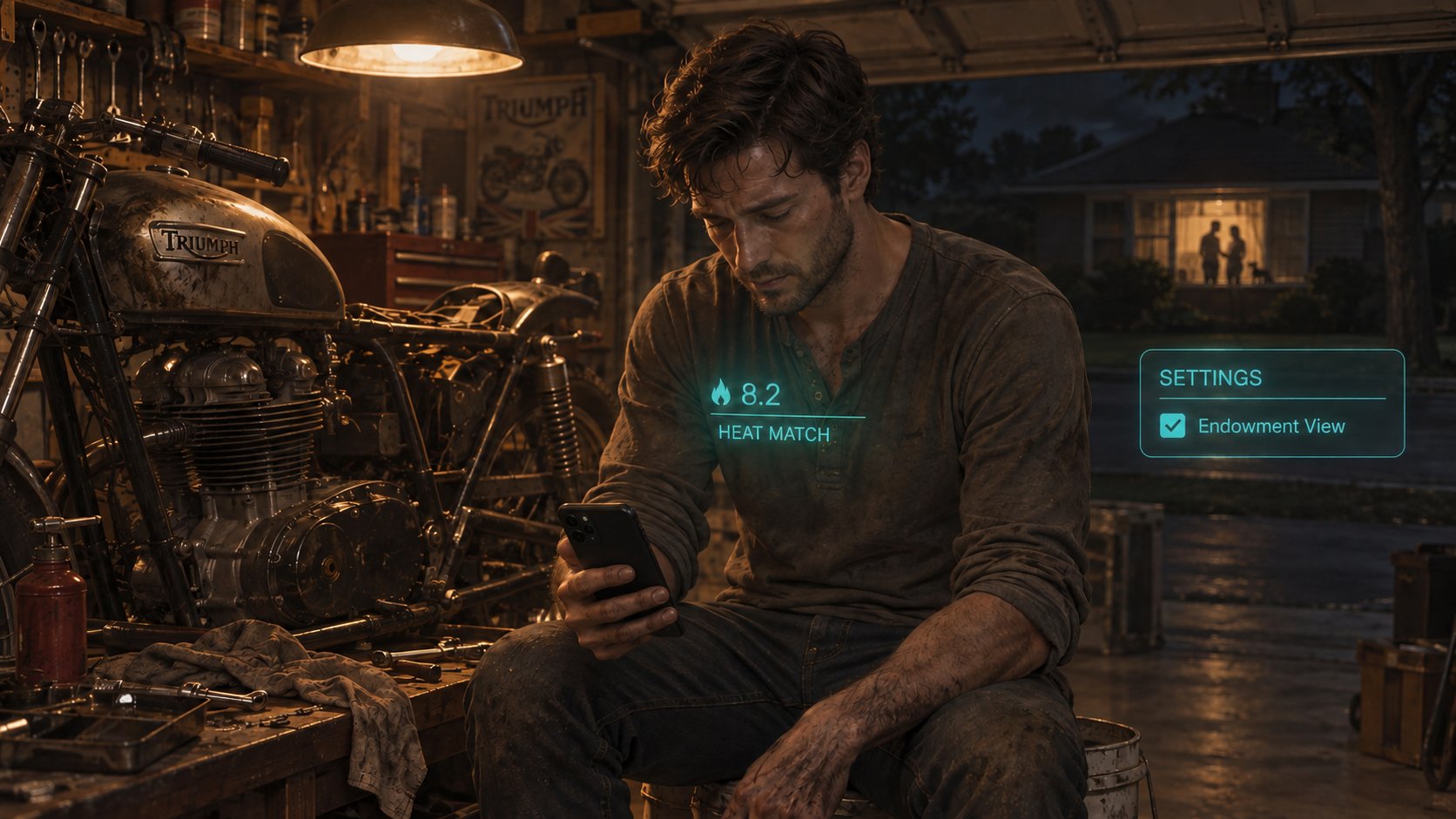
My name is Cole. I’m thirty-one, I rent on the east side of the city and I restore motorcycles in my brother’s shop. Those things are who I feel I am but to others, I worry that those things don’t identify me as distinctly as the teal number floating above my beltline everywhere I go. It has been there for four years and I feel like it will be there for the rest of my life. It is the first thing anyone knows about me, it is often the only thing anyone wants to know about me, and it reads 8.2.
Let me catch you up, in case you’ve somehow been able to live in today’s society without your AR glasses. One Tuesday in March, a medical data conglomerate lost forty million patient files to a breach, the biggest breach in history, though the records stopped being the story within a week, because of what happened next. By that Friday, the AR lens companies had enabled an option in their settings menus, right between color correction and captioning, called Endowment View. You look at a man, and there it is, a discreet teal number at about chest height, just above his beltline, giving his length and girth, certified against his most recent physical. Accurate. Current. Updated automatically when his body changes. Nobody voted on it. Nobody was asked. It simply became the world, the way weather becomes the world.
The teal numbers leave no man’s anatomy a secret anymore. That’s the line the news anchors used that first week, and it’s true, and I want you to hold onto the shape of that sentence, because this is a story about what it costs a man to have no secrets in a world that has decided his one secret is the only thing about him worth displaying.
Everybody assumes the number over my head is the best thing that ever happened to me. And it is but it has also quietly ruined my life and any attempt for deep connection. Both of those are true at once, and I’ve given up on trying to make them fit together. I’m just going to show you both sides and let you keep what you need.
Start with the good news, because there is a lot of it, and pretending otherwise would make this a different kind of lie.
I have never been turned down for a date in the transparent age. The apps call men like me “heat matches” and there’s a little flame icon that appears on your profile when your certified number crosses that number, and I’ve had mine since the filters went live. Women set floors the way they once set distance, height or weight. Nothing under seven, nothing under eight if they’re feeling ambitious. My inbox has four thousand matches in it. I could fill every Tuesday for the rest of the decade without ever meeting the same woman twice.
That’s the good news. I told you there was a lot of it.
Now here’s the math beneath it. A woman in this world who wants a life, a home, a marriage, someone at the table at Thanksgiving an emotional partner is usually not looking for a heat match. She’s looking for what the apps call a devotion match, and she filters accordingly, and then, if her devotion match’s number isn’t everything her body needs, she augments with a heat match like me. Marry the devotion match and book an appointment with the guy with the flame icon. That seems to be the standard arrangement now, so normal the sociologists have a word for it and the word is boring, which I suppose is what happens to any revolution once it gets its own vocabulary.
Which means that I, an 8.2, am not a husband candidate. I am an line item, a date you schedule for meeting the shortcomings of your devotion match. I am the thing you schedule.
I’ve heard women say “you don’t keep an eight” like advice about not planting tomatoes too early. It means a man with a large number is a shared resource. It means wanting to keep me is like wanting to keep a summer, technically possible, structurally doomed, and a little embarrassing to admit to your friends. Those flame matche guys have too many options, you wouldn’t be able to keep one if you tried.
I went on a third date last year with a woman named Rachel. She was a cardiologist, funny in a dry way, and I liked her enough that on date three I said the thing you’re apparently not supposed to say anymore, which is that I’d like to meet her friends. I watched the sentence land on her like a dropped glass. She was quiet for a while and then she said, gently, the way you’d deliver a diagnosis: “Cole. You’re an 8.2. What would we even be?”
What would we even be. I’ve thought about that question for almost a year. I have a garage full of old motorcycles and I can tell you the year of an engine by the sound of it turning over, and no woman I have dated since the Toggle has ever asked me a single question about any of it. Why would she? The answer is floating over my head in teal. The answer is 8.2. The question of what we would even be has already been answered by the machine, and the answer is: a hookup.
The strangest thing about the number isn’t women. It’s men. The day Endowment View shipped, I was twenty-seven, and to be honest I didn’t feel violated when that day came. That came later, as I realized what it really meant for me. At the moment, that first few weeks, were the greatest day of my life. I’d spent my twenties being a guy with a quiet of confidence and a loud kind of doubt, same as everyone and then one Friday there was a teal number over my head, and the number told everyone I was good, and the world’s entire accounting of me flipped in a single update to the AR headset. Strangers were warmer. Bartenders poured heavier. A woman at my gym stopped to ask me out in the middle of her workout. For about a month I walked around in the warm comfort of feeling seen, and I’m not going to pretend I hated it, because I didn’t hate it. The euphoria was real. It just had a very short half-life, and nobody warned me, because nobody knew.
Then came the men. Men toggle on more than women do, if you can believe the surveys, the more information is better, was the general consensus, and men meant it the way a poker player means it. And a number changes how men look at you. There’s a deference you start receiving from some of them, this wary sideways respect, like you’re a piece of heavy equipment they’re being careful around. And there’s something else from the others, an envy, a brightness, a needling, an edge. Men at the gym need to tell me their bench numbers now, unprompted. Men at the parts counter need me to know their bikes are faster than mine. I never asked for a ranking but I got one anyway, and I occupy a spot in it and every room of men I walk into has already sorted me before I’ve said hello, and the sorting runs on the same teal font that everything else in this world runs on.
And the husbands. I need to tell you about the husbands, because I didn’t see this coming at all. A husband always knows. That’s the thing. When I’m out with Lena, or Mary, or Jules, and we run into someone she knows, I watch the husband’s eyes do their own math. They glance down, flick up, and then I watch him get careful. Not hostile, usually. Careful. A certain softening of the shoulders, a conversational gentleness, pretending he is ok with it but calculating his number, subtracting his own and coming up with the exact number of inches that I go where he simply cannot.
Some of them are grateful, and the grateful ones are the hardest to be around. One of them, Mary’s Doug, though she doesn’t know I know it was him left a six-pack of beer on my porch once with no note, and I understood exactly what it was. It was a tip. I stood there on my own porch holding a stranger’s tip for services I never agreed to bill for, and that’s the night I started writing this story in my head.
Before the Toggle, I was a man. After the Toggle, I was a category. And the cruelest joke the category plays is that everyone in it is alone for the same reason, and we can’t even organize — there’s no union for eights and ups, no support group, because men would rather eat glass than sit in a circle and admit the number hurt them. It should have hurt the small men. Everyone assumed it would hurt the small men. Nobody budgeted for us.
I date three women. Or as modern sociologists would say, I supplement three women and I feel like the word supplement is more accurate than date. It’s a little like being described as a vitamin because I really just make up for whatever they lack in their day to day meals. Their names are Lena, Mary, and Jules, and all three of them call me their boyfriend, and I want to talk about that word for a minute, because I think it might be the loneliest word in my life.
Lena is the one you may have met, in a manner of speaking because she tells our story from her side, and she tells it better than I ever could, and in her version I’m the fire. It’s the kindest thing anyone has called me in years. It is also, if you look at it straight, a job description. In her telling I’m also, and she says this affectionately, terrible at texting. She’s not wrong. What she doesn’t know is why. You answer fast when answering is the whole job but somewhere in year two I started leaving the “u up”s on read for an hour, then an evening, then a day, not to punish anyone, not to play anything. I feel like I did it just to be, for a little while, a man nobody is waiting on. Lena is thirty-four, married to a man named Graham, and I’ll come back to him, because I need to come back to Graham. He is, after all the reason I’m writing this down at all.
Mary is a corporate lawyer, married to a man named Doug, who is a 4.6, he is a very loving husband to her, he remembers her friend’s birthdays and handles their bills and family matters like a pro. Doug is, by every measure this world pretends not to use anymore, a good man. I’ve never met him. I know his number, his birthday month, and his opinion on their kitchen renovation, because Mary tells me everything. As we lay beside each other in bed she loves to tell me the goings on in their life, her main life, the life I’m not allowed to be a part of. I’m the extra, the icing on the cake of her life.
And Jules is an ER nurse whose schedule is insane and makes mine look like a blank slate. I see Jules maybe once a month, I give her what she wants and she falls asleep afterward, every time, like a switch flips, and I lie there listening to her breathe and feeling like a very effective piece of medical equipment in her hospital.
Here is the thing about the u up texts, and I need you to understand that I’m not complaining about the sex. I love women and the sex is good. I am happy with the blessing of the number I have, with a number like that, the sex has never once been the problem. The problem is what the texts represent for me, my worth in the lives of my girlfriends. When I get a “u up” at 11:42pm it is not a woman checking on me to see how I am doing. It’s a woman checking my availability, a woman who wants to experience the mathematical difference between her husband’s number and my number. And after four years I have gotten fluent in the language of it, the way you get fluent in anything you’re exposed to nightly. I know Mary’s cycle better than her husband does, and I never meant to but I learned it from her texts. “Hey stranger” is the follicular phase. “You around this week?” is the luteal dip, mild, low-stakes. And “u up” with no punctuation, sent between eleven and midnight, is ovulation, every time, with the reliability of a train schedule. I did not choose to become a calendar but I became one anyway, because that is the shape of what I am to them, a service with a scheduling system.
They call me boyfriend, all three of them, and I’ve started to hear the word the way you hear a euphemism. Boyfriend is what you call the man you don’t introduce to your parents. Boyfriend is the word that makes it romantic, the way “seeing someone” makes it ambiguous, it’s not a lie, exactly. It’s a costume that her truth wears so everybody can normalize it. I’m wanted some of the time and needed never, and wanted is a warm thing right up until you notice that nobody in your life would notice if you got sick for a month, except for a couple lonely Tuesdays nights that she would have to resort to masturbation before she falls asleep watching television or reading.
In fact, I got food poisoning back in February. Bad, the kind where you’re on the bathroom floor and trying to figure out whether I could afford to call an ambulance if it got any worse. The fact that I had to do math about calling an ambulance tells you everything about being thirty-one and single in this economy of ours. I get by. Restoring motorcycles has never been a lucrative business but it pays the bills, I guess.
I lay there and I scrolled my phone, which had 4,227 matches in it (not exaggerating), three women who call me boyfriend, and not one person I could call to help me with my food poisoning. I actually went through the contacts. That’s the pathetic part, I went name by name, looking for the person who would bring me soup, and every name was a booking slot. To add insult to injury, Mary texted that night with her typical “u up?” and I typed back “sick” and she sent a heart and “next week?” and that’s not cruelty. I want to be fair to her because it’s really not cruelty, it is just the shape of what I am, doing exactly what it was shaped to do.
The only room in my life without numbers in it is the garage. Motorcycles. British bikes mostly, Triumphs, the odd BSA and there’s a forty-minute window, maybe an hour, when a carburetor is apart on the bench and my hands know what they’re doing and nothing in the world has a readout over it. My father taught me engines before any of this happened, before the breach, before the teal numbers defined my worth, and sometimes when I’m deep in one I think about how he never once in his life knew a single number about any man he wasn’t related to, and I try to imagine what that felt like. I can’t. It’s like trying to imagine a color. That’s the part the sociologists miss, I think, it’s not that the numbers are cruel. It’s that the world before them has become unimaginable, even to the men who lived in it.
Last month, the startup that shipped Endowment View, just announced its next feature. They’re calling it Connection Score. In beta this spring. Here’s how it works, after an encounter, a woman can rate the man, one tap on her lenses, and the rating aggregates into a percentile that displays under his readout. Right under the teal size number, in smaller type, how he used that number, crowdsourced, current, and public. The announcement used the phrase “empowering informed choices.” The internet immediately started calling it the After-Score, which is funnier and worse, because it’s accurate, your entire life is a performance, and it is graded for all to see. And the worst part, is that I can’t think of a single thing that number will tell anyone about me either. They’re going to grade the only part of me anyone looks at, and the rest of me is going to keep standing there, with my hands covered in grease in the garage sitting on an overturned bucket, holding a wrench. The motorcycles see me. Only the motorcycles see me.
Will it ever stop. I don’t mean that as a rhetorical flourish. I’m actually asking somebody, anybody will it ever stop? Because look at the shape of it. First they displayed what we have. Now they’ll display how we perform. What’s the next true thing? Stamina, measured in minutes? Recovery time? A five-star system, little teal stars floating over your beltline at the bar, so a woman can comparison shop before she says hello? Every metric they add narrows the channel a little more, and every woman I know says some version of the same thing, more information is better, why wouldn’t you want to know? I understand it, I do, I ran the filters myself when I still had a profile. But nobody seems to notice that the machine doesn’t stop at one true thing. One true thing was the free trial. Being reduced to a score takes away my humanity and my humanity is all that makes life worth living. There’s no connection when I know that my performance determines my five star rating, it’s transactional. My life is a transaction and my worth is represented only by how well I fuck. How well I satisfy these women who married men who couldn’t satisfy them only to be supplemented by men who are defined only by their score. Oh how I envy the men with low scores sometimes, probably the way they envy the men with high scores. I want to be the meal, not the dessert in the way they want to be the dessert sometimes.
Now Graham. I promised I’d come back to him. Graham is Lena’s husband. He’s thirty-six, he cooks like it’s a love language, and he is 4.3. I knew his number before I knew his name because everybody did, that’s the whole point of the world. For the first year of my arrangement with Lena, that’s all he was to me. A number. The deficit her friends didn’t mention and I was the reason her books balanced.
Here’s what I’d like you to sit with for a second, because it took me two years to say it out loud, and I’m going to say it here first, to strangers, because that’s apparently what my life is now. I am jealous of a man with a 4.3, not of his number but everything else. Of the fact that when Lena comes home from my apartment at one in the morning, there is a kitchen light on and a man standing in it with the dog, and she walks into that light like a ship coming into harbor. I drop her at the curb and I watch it happen through the window of my truck, every time, and every time it lands in me like weather. Being wanted is not the same as being waited for. I have an 8.2 and a full calendar and I do not have a kitchen light that’s on for me anywhere in this city. Nobody that loves me in a way that doesn’t depend on that stupid number above my head.
The handoff, if you’ve never seen one, is a whole genre of awkward. Graham comes to the door sometimes when I walk her up. He’s gracious, because it’s impossible to resent him, and I’ve tried. “Thanks for bringing her home,” he says, like I’ve done him a favor, like I’m a colleague who stayed late at the office. And the dog is circling his feet, and he’s already turning inside to make the tea, and I stand on the porch of a house I have been inside exactly three times, holding the empty space where a woman was, and I drive home with the windows down in every month of the year.
One time after dropping Lena off, Graham wouldn’t hear of me driving back across the city and invited me to stay for dinner. He cooked for three. He made this caramelized fennel thing that was wonderful, and the dog sat on my feet the entire meal like she was holding me down, and Lena laughed at Graham’s story about a raccoon that I could tell she’d heard eleven times, and for about two hours I was not a booking. I was at a table, I felt for a moment like I had any idea about what it was like to be the cake instead of the icing. There is a difference, and I didn’t know how big it was until I felt it, and I’ve been chasing it since like a man who got one perfect day of some drug. When I left that night, Graham shook my hand at the door and said, “Same time next month?” and he meant it kindly, he genuinely did, and it still took the skin off me. Same time next month, he coldly defined my place in their lives even though I think he did it to be kind, it stung.
The detail that finished me, though is the green dress. Let me explain. Early on, month three, maybe. Lena showed up at my place in this green dress that stopped me in the doorway, and when I told her she looked incredible, she said, absent, already looking for the wine. “Graham picked it. He has opinions.” Her husband dresses me for our dates. I’ve turned that over for two years and I still can’t get it to be anything other than the most devastating sentence I know. Not because it’s humiliating because it isn’t, that’s not what it is. It’s intimate in a way that doesn’t register in my brain. He knows what she’ll wear to me. He has opinions. He is inside her life down to the fabric, and I am inside it exactly one evening at a time, in a dress he selected for the occasion. He gets to choose the version of Lena that I get to experience.
Lena told me, once, over that wrong-night wine, what she told her friend Dana at a dinner party I wasn’t at. She told Dana the whole architecture of our “relationship.” She explained the shame she carries about Graham’s number, the way the room does its little math about his shortcomings in life. Then she said the sentence that drove chills down my spine, not because it was mean or untrue, but because it was a truth that defined my life, “Cole fills an evening. Graham fills a life.”
Fuck. She meant it as geography and she meant, here is the map of me, here is the territory of each of you, nobody has to pretend the map is different than it is. She’s an honest woman and it’s her finest quality. It’s also, occasionally, a knife she doesn’t know she’s holding. I laughed when she told me. I laughed, and I topped up her glass, and I went home to an apartment where nobody was waiting with the light on, and I stood in the kitchen and said the sentence out loud to the refrigerator just to hear how it sounded. Cole fills an evening. It sounded exactly like the truth. That’s the thing about this world I can’t get over. Nobody lies to you. Nobody has to anymore. The truth just hangs there as a teal number, over everyone, all the time, and it turns out the truth was never the thing that was going to save us.
So that’s where I am. Thirty-one, 8.2, a garage full of engines and a phone full of women that want to feel an 8.2 because they only have a 4.7 at home. The are all waiting on a feature update that will grade my worth like a fucking Yelp review. I’m wanted some of the time but needed never. Boyfriend, three times over, in the way a gym is a home.
Last Tuesday, Mary’s text came in at 11:42. “u up” with no punctuation as usual, right on schedule, the Mary train arriving at the station. And I sat on the edge of the bed with my boots half off, and for the first time in four years I didn’t answer it. Not because I don’t want her. I do. Because that crumb of passion is worth something to me but I read the text three times and understood, finally, what had been bothering me about it. It had been bothering me since February, since the bathroom floor, since the soup I didn’t have anyone to bring me. It is not a question. “u up” has never once been a question. It is a booking confirmation. And somewhere between the third read and the morning, I decided I would like, one time before I die, to have a question mark after it. To be the man someone asks how his day was, on a day that isn’t assigned, or in a way that isn’t a pleasantry. To be introduced. To a friend. To a father. To be the answer to what would we even be.
I answered her in the morning, but I told her something true, which is that I’d like to have dinner some night. A table, I said. Food, and a table, and no clock on it. She wrote back a heart and a “next week?” and I understand that Mary is not the villain of this story. There are no villains in this story. That’s what nobody tells you about the transparent age because this machine didn’t need villains. It just needed everyone to be honest at the same time.
Lena ends her side of this story by taking her lenses out every night when she gets home, the one unfiltered room in her life, the kitchen, the man, the dog. I don’t have a room like that. But I’ve started doing it too, in the garage. Lenses out, I’ve been doing this long enough that I don’t need the lenses for the motorcycle schematics. I could take this damn thing and put it back together by memory, I don’t need lenses for that.
I want the lenses out because I want the world back to its old color, the color my father knew, the one I can’t imagine anymore. I keep a mirror in the garage, by the workbench, and when the lenses come out, the teal number over my beltline goes with them, and for my time in the garage, I’m the only man left in the world with no number on him. I look at myself in that mirror and I think about what I’d want the readout to say, if readouts told the truth. Not the length. Not the percentile. Not the stamina. The truth.
The Toggle shows one true thing about me. It’s the only thing anyone needs me for, anymore. Somewhere out there is a woman who will ask about the rest of it, my fascination with engines and how they work, my father, the garage, the color the world used to be. I’ll tell you the honest thing, the thing this whole story has been walking toward. I don’t know if she exists, but if she does, she’s not in my inbox. Four thousand matches, and she’s not in there. I know she’s not in there so I’m going to leave my four thousand matches in there and go back out to the garage, again.

Overall this story was depressing, my whole life I’ve wanted to be Cole but i feel back for him somehow. Well written story Emma
Ouch 🤕 twice
One I know a guy just like that he’s one of my best buds and god does he go through it he’s almost given up on getting into a relationship
And two me and a few of the boys are considered high value men we always got to be on gard for those that just want to …… You get it ……
All that being sead omg that was something amazing a good look at the other side of things well done Tora I mean that 💯 good job