

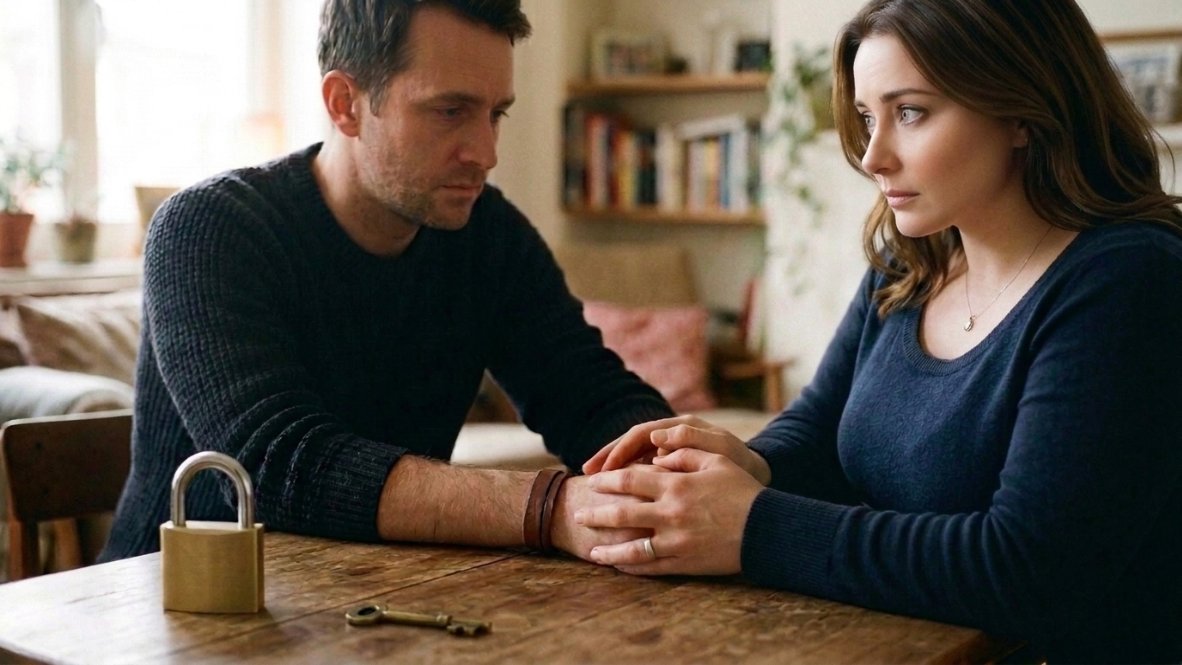
Let me tell you something, right from the jump. I’m not a therapist. I don’t have a PhD hanging on my wall, even though I’ve read enough psychology texts to fill a decent library. I’m not a relationship coach, and I’m certainly not here to sell you a course or a dream. I’m just a woman who was staring down the barrel of a divorce she didn’t want, and I figured something out. Something that saved my marriage. Something that woke up a man who had gone so quiet inside himself that I’d forgotten what his hunger looked like.
I’m Shasta. I’m educated, yes. I read, I think, and I’ve always had a fascination with the human mind, particularly the parts of it that govern desire. But before I was any of that, I was a stripper. And before you click away or judge, let me tell you something: those years in the club taught me more about male psychology than any textbook ever could. When you’re standing on a stage in heels and nothing else, and a man with a pocket full of cash sits down in front of you, you learn very quickly what makes the male mind tick. You learn what it wants, what it fears, and most importantly, what it’s willing to chase. It’s a game of cat and mouse and this cat is feral.
So when my marriage to Bryan flatlined, when we’d gone so far as to tell our families we were separating, when we were sleeping in different rooms and the word “divorce” had stopped sounding scary and started sounding like a relief, I did what any smart woman with a background in human behavior would do. I got strategic. This is my story. But it’s also yours, if you want it to be.
The Dead Bedroom and the Man Who Stopped Trying
Bryan and I had been together long enough that the silences between us had become their own language. And that language said, I don’t want you anymore. We weren’t fighting. That was the problem. Fighting would have meant something still burned. Instead, we were polite. We were courteous. We passed each other in the hallway of our own home like coworkers in an office, nodding, stepping aside, saying “excuse me” as if we hadn’t once torn each other’s clothes off in that same hallway.
We’d talked about divorce. Not in the dramatic, plate-throwing way. In the quiet, exhausted, “maybe this is just how it ends” way. We told his mother. We told my sister. We started using words like “co-parenting” and “selling the house” and “moving on.” And through all of it, there was this thread between us, this stubborn, unbreakable little thread that neither of us wanted to cut. We loved each other. Not in the way that makes your pulse race anymore, but in the way that makes you feel like the world would be colder without this person in it. It’s complicated, we told ourselves. It’s complicated, we told everyone.
But here’s what I knew, sitting alone in the guest bedroom one night, staring at the ceiling: Bryan had given up. Not on me, exactly. On being a man who desired. On being a man who pursued. Somewhere along the way, between the mortgage and the routines and the slow erosion of novelty, he’d stopped reaching for me. And when a man stops reaching, he starts shrinking. Not physically. Psychologically. He becomes smaller in his own life. He becomes passive. He becomes agreeable in the worst way, the way that means he’s no longer engaged.
I didn’t want a divorce. I really, truly didn’t. But I also knew that I couldn’t manufacture desire where none existed. I couldn’t just put on lingerie and hope for the best. That would have been pathetic, and I am not a pathetic woman. I needed something structural. Something psychological. Something that would shift the entire dynamic of our relationship at its root.
I needed to take control.
The Proposal He Didn’t See Coming
I brought it up on a Tuesday. I remember because Tuesdays were our most neutral day. No history of arguments on Tuesdays, no bad news ever delivered on a Tuesday. I sat him down at the kitchen table, and I told him I wanted to try something.
“I want you to lock yourself up for me,” I said.
Bryan looked at me like I’d spoken in a foreign language. “Lock myself up?”
“Male chastity. A device. I hold the key.”
He laughed. Not cruelly, but dismissively. The way men laugh when they’re uncomfortable and don’t want to show it. “Shasta, we aren’t even sexual. Why would denying sex do anything at all? There’s nothing to deny.”
And there it was. The exact response I expected. Because Bryan, like most men, thought chastity was about denial. About taking something away. He couldn’t fathom what I already knew: chastity isn’t about what you take away. It’s about what you create.
I didn’t argue. I didn’t push. I just smiled and said, “Okay. Think about it.”
Here’s the first lesson, and I want you to write this down if you’re taking notes: Never argue a man into submission. Let the idea sit. Let it marinate. Men are stubborn when they feel cornered, but they’re curious when they feel unpressured. I’d learned this in the club. The men who spent the most money were never the ones you begged. They were the ones you hinted to. The ones you made feel like the idea was theirs.
I let it sit for two weeks. I didn’t mention it again. But I started changing other things.
The Show Begins
I started with the small things. The things he wouldn’t consciously notice but his subconscious would register like a seismograph picking up a tremor.
I stopped wearing my “around the house” clothes. You know the ones. The oversized t-shirts, the sweatpants with the hole in the knee. Instead, I started wearing things that fit. Not provocative things. Not lingerie around the kitchen. That would have been too obvious, and Bryan would have seen right through it. No, I wore fitted jeans. Tops that followed the line of my body. Dresses that moved when I walked. I wore my hair down more often. I put on a little mascara, even when I wasn’t leaving the house.
I wasn’t dressing for him. That was the key. I was dressing for me. And he could feel the difference. When a woman stops disappearing into her clothes, when she starts taking up space again, a man notices. Not with his eyes first, but with something deeper. With that animal part of his brain that says, She’s here. She’s present. She’s someone.
I started touching him again. Not sexually. Not yet. I’d put my hand on his shoulder when I walked past. I’d brush against him in the kitchen. I’d sit close enough on the couch that our knees almost touched. Almost. The almost is important. The almost is everything.
In the club, we called it “the almost.” The dance where you get close enough that he can feel your heat but not your skin. The moment where his wallet is already half open and he doesn’t even know why. It’s the gap between what he has and what he wants, and that gap is where all the power lives.
I was creating a gap. And Bryan was starting to feel it.
The Psychology of the Lock
Let me explain what I was actually doing, because this is the part that matters and this is the part I want you to understand.
When a man has unlimited access to something, he stops valuing it. This is basic behavioral psychology. Pavlov, Skinner, all of them. If the reward is always available, the behavior that pursues it extinguishes. Bryan had unlimited access to me for years. Not sexually, we’d stopped that months ago, but emotionally, physically, domestically. I was always there. Always available. Always predictable. And so he’d stopped pursuing.
But here’s the flip side that most people miss: when a man has unlimited access to himself, he also stops valuing himself. Bryan had unlimited access to his own pleasure, his own release, his own autonomy. And in that unlimited access, he’d become complacent. Not just with me, but with himself. He’d stopped taking risks. Stopped being ambitious. Stopped feeling like a man who had something to prove.
Chastity, when done right, doesn’t just deny a man his orgasm. It returns him to himself. It makes him earn what he’d been taking for granted. And in the earning, he wakes up.
After two weeks of my “show,” as I called it, the touching, the dressing, the almosts, I brought it up again. This time, I was more prepared.
“You asked me why denying sex would do anything when we aren’t having sex,” I said. We were in the living room. I was wearing a dress that hit just above the knee. He was in his chair, the one he always sat in, and I could see he’d been watching me. Really watching me, for the first time in months.
“This isn’t about denying sex,” I said. “This is about giving you something to focus on. Something to work toward. You’ve been sleepwalking, Bryan. And honestly? So have I. I want to wake us both up.”
He was quiet for a long time. And then he said something that told me I’d already won.
“What would it look like?”
Not “no.” Not “that’s weird.” Not “I’m not doing that.” He asked what it would look like. When a man asks what something would look like, he’s already imagining it. He’s already there.
The First Lock
I bought the device myself. A simple silicone cage, nothing extreme, nothing intimidating. I chose silicone because it was comfortable, because I wanted this to be sustainable, not a punishment. This is crucial, and I’ll say it again: chastity is not punishment. Chastity is structure. If you approach it as punishment, you’ll breed resentment. If you approach it as structure, you’ll breed focus.
I showed it to him on a Sunday morning. I didn’t make it ceremonial. I didn’t make it heavy. I just set it on the nightstand between us, the nightstand that had become a border crossing between our separate countries, and I said, “Whenever you’re ready.”
He looked at it. He picked it up. He turned it over in his hands. And I watched something happen that I’d seen a hundred times in the club but never thought I’d see in my own marriage. I watched a man get curious. Not sexually curious, not yet. Psychologically curious. The way a man gets when he encounters a puzzle he can’t immediately solve.
He put it on that afternoon. He didn’t say much. He just went to the bedroom and came back ten minutes later, and he was different. Not visibly. Not in any way you could photograph. But I could feel it. The energy in the room shifted. He was suddenly aware of himself in a way he hadn’t been before. He was aware of me in a way that had gone dormant.
I held the key. I put it on a chain around my neck, where it hung between my collarbones, visible but not explained. He saw it. He didn’t say anything. But his eyes tracked it.
And that’s when the real work began.
The Rules I Made (and the Ones I Broke)
I didn’t give him a list of rules. That’s a mistake a lot of women make when they first try this. They get drunk on the power of the key and they start issuing edicts like a tiny dictator. That’s not seduction. That’s bureaucracy. And bureaucracy kills desire faster than a dead bedroom ever could.
Instead, I gave him one rule. Just one.
“Ask me,” I said.
He looked confused. “Ask you what?”
“Anything. Everything. If you want to touch me, ask. If you want to kiss me, ask. If you want to come, ask. Not because you need permission, but because I want to hear your voice say what you want.”
This is the part that’s hard to explain to someone who hasn’t lived it. I wasn’t trying to control Bryan. I was trying to make him verbalize his desire again. A man who has stopped asking for what he wants is a man who has stopped wanting. I needed to make him ask. Not beg, not plead, not grovel. Just ask. In his own voice. In his own words.
The first time he asked to kiss me, we’d been in the cage for four days. Four days of him being aware of the device, aware of me, aware of the key around my neck. Four days of me being present and warm and close but not available in the way he was used to. Four days of the “almost.”
He was washing dishes. I was drying them. Our hands brushed. He stopped.
“Can I kiss you?” he said.
It was such a simple question. Such an ordinary question. But neither of us had asked it in years. We’d just done it or not done it, mechanically, habitually, the way you brush your teeth or check the mail. He was asking. And the asking changed everything.
“Yes,” I said.
He kissed me. Not the way he’d kissed me in years, the perfunctory, closed-mouth, “see you later” kiss. He kissed me like he meant it. Like he remembered how. Like the cage had reminded him that his mouth was his own, and he could use it to say things and to do things that mattered.
I didn’t let it go further. I pulled away first. I smiled. I went back to drying the dishes.
And I felt something I hadn’t felt in a very long time. Power. Not the cheap, performative power of a woman who knows she’s pretty. The deep, structural power of a woman who knows she’s wanted.
The Striptease of Everyday Life
Here’s where my background came in handy. Because a striptease isn’t about taking off clothes. Anybody can take off clothes. A striptease is about the moment between one state and another. It’s about the reveal. And the reveal only works if there’s been a conceal. If you walk onstage naked, there’s no show. If you walk onstage in a parka and take it off in two seconds, there’s no show. The art is in the pacing. The art is in making him wait for each layer.
I started applying this to everything.
I stopped answering questions immediately. Not rudely. I’d pause. I’d look at him. I’d let the silence build for just a beat longer than comfortable. And then I’d answer. It drove him crazy in the best possible way.
I started getting dressed in the morning where he could see me. Not naked, not provocative. Just the process. The bra going on. The shirt buttoning. The skirt zipping. These were things he’d seen a thousand times and stopped seeing at all. But now, with the cage on and the key around my neck, every layer I added was a layer he couldn’t remove. Every button I buttoned was a button he hadn’t been asked to undo. And that gap between what he saw and what he could have, that gap was the striptease.
I started sending him texts during the day. Not dirty texts. Not “I’m so horny” texts. Just observations. “I saw a man look at me today and I thought of you.” “I’m wearing the blue dress. The one you like.” “I took the key off in the shower and held it in my hand and thought about whether you’d been good today.”
That last one. That one made him text back in under thirty seconds. I’d never gotten a response that fast, not even when we were dating.
Week Two: The Shift
By the end of the second week, Bryan was a different man. Not because I’d changed him. Because I’d given him a reason to change himself.
He started cooking dinner. Not because I asked him to, but because he wanted to do something for me. Something that wasn’t about the cage, something that wasn’t about sex, something that was just… effort. Visible, tangible effort directed at me.
He started opening doors again. He started standing when I entered a room. He started looking at me when I talked, really looking, not the half-listening, phone-in-hand looking that had become our default.
And at night, in the dark, in the bed we’d started sharing again, he’d reach for me. Not always sexually. Sometimes he’d just put his hand on my hip. Sometimes he’d press his forehead against my shoulder. Sometimes he’d whisper things he hadn’t whispered in years.
“I miss you,” he said one night. “You’re right here and I miss you.”
“That’s the point,” I said. “Missing me means you want me. Wanting me means you’re alive.”
He held me tighter.
The Release (and the Re-Cage)
I let him out for the first time after twelve days. Not because he’d earned it on a schedule, but because the moment was right. It was a Saturday. Rainy. We’d spent the day together, not doing anything special, just existing in the same space with a new awareness of each other.
I took the key from around my neck. I held it up. He watched it the way a man watches a coin spinning on a table, unable to look away.
“I’m going to unlock you,” I said. “And when I do, I want you to remember what this feels like. Not just the release. The wanting. The waiting. The asking. I want you to remember all of it.”
He nodded.
I unlocked him. And what happened next wasn’t sex, not the way we used to have sex, the routine, predictable, are-we-done-yet sex. It was something else. It was a man who had been given back something he’d forgotten he valued, and he treated it like it was precious.
I won’t describe the details. Some things are sacred. But I will tell you this: he looked at me the way he used to look at me. Before the routine. Before the resentment. Before the silence. He looked at me like I was the only thing in the world that mattered.
And afterward, he handed me the device and said, “Put it back on.”
I did.
What I Learned and What You Can Away
I’m not going to pretend this is a one-size-fits-all solution. Every marriage is different, every man is different, and every woman’s tolerance for this kind of work is different. But I’ll tell you what I learned, and if any of it resonates, take it. If it doesn’t, leave it.
First: Desire is not something you find. It’s something you create. Bryan and I didn’t have a desire problem. We had a structure problem. We’d built a life where desire had no place to grow. Chastity gave us a new structure, one where desire was not just possible but necessary.
Second: A man who has to ask for what he wants is a man who knows what he wants. The cage didn’t make Bryan submissive. It made him articulate. It made him conscious of his own desire in a way that unlimited access had erased. When you remove the autopilot, a man has to fly manually. And most men, it turns out, are better pilots than they think they are.
Third: The key is not a weapon. It’s a conversation. Every time I held that key, I was saying something. “I see you. I value you. I believe you have something worth containing.” And every time he wore the cage, he was saying something back. “I trust you. I’m willing to try. I’m still here.”
Fourth: You have to be worth the lock. This is the part that’s not fun to talk about. If you’re going to ask a man to give up his autonomy, even temporarily, even willingly, you have to be a woman worth giving it up for. That means you have to show up too. You have to be present. You have to be the woman he’s locking himself up for. Not the sweatpants woman, not the “we’ll talk about it later” woman. The woman he fell in love with, the woman who made him feel like pursuing something was worth the effort.
I had to become that woman again. And in becoming her, I found that she’d been there all along. I’d just stopped letting her out.
Where We Are Now
Bryan and I are still together. We sleep in the same bed. We’ve called off the separation. We told our families it was a rough patch, and they believed us because rough patches are normal and divorce is dramatic and people prefer the normal story.
The cage comes off and goes back on. It’s not always on a schedule. Sometimes it’s on for days, sometimes for weeks. Sometimes I unlock him because I want him, and sometimes I unlock him because he’s earned it, and sometimes I unlock him just to watch his face when the constraint lifts and he remembers what freedom feels like.
We have sex now. Real sex. Sex that feels like two people who want each other, not two people fulfilling an obligation. And the sex is better than it was when we were dating, because now there’s context. There’s buildup. There’s the long, slow, delicious tension of a man who has been waiting and a woman who has been worth the wait.
Bryan is different. He’s more present. He’s more ambitious at work. He’s more engaged with our friends, our life, our future. He says the cage reminds him that good things require patience. He says it makes him appreciate everything more, not just sex, not just me, but everything.
And me? I feel like myself again. Not just a wife, not just a roommate, not just a woman slowly disappearing into the background of her own life. I feel like the woman I was in the club, the woman who knew what she had and knew how to use it. The woman who understood that power isn’t about taking. It’s about holding. Holding attention. Holding desire. Holding the space between what a man wants and what he has, and knowing that that space is where everything alive happens.
A Final Word for You
If you’re reading this and your marriage feels like mine felt, I want you to know something. The passion isn’t gone. It’s not dead. It’s just sleeping. His libido is the lifeblood of the energy he adds back into the marriage. If his libido is directed elsewhere so is his relationship energy and sometimes, to wake something up, you have to put it in a cage first.
Not forever. Not as punishment. Just long enough for it to remember what it wants.
The key is around your neck. It’s always been around your neck. You just forgot you were wearing it.
Now use it.

Thanks Shasta I appreciate you sharing your story with us!
I have to admit, this is probably the best and most compelling depiction of a balanced and loving chastity situation that I’ve read. No humiliation, no coercion, and no dramatic redefining of what sex is.
Agreed – the starting situation almost sounds like something I’m familiar with, too familiar. Sounds like an anonymized real life story.
At the beginning of this piece, I thought, ‘here we go again.’ Always the husband. Never the hapless wife. But as the story unfolded, it demonstrated the one thing that’s missing from so many of this kind of account – and that’s shared accountability. Relationships don’t go stale unilaterally. For the spark to return takes shared effort and commitment. And empathy. That’s what this story has in spades – along with some very solid leadership.
Love it!
And it’s good to see you back Em. Hope it was a great holiday. Kev OK?
I’m great! Thanks for asking. Kev is wonderful too.
Very well writen and believable. Nicely handled Shasta!